 ChipApex | Global Electronic Components Supplier
SEARCH
Search Product
Search Post
— IC芯片 | 连接器 | 传感器 | 被动器件 —
Search productSearch post
— IC芯片 | 连接器 | 传感器 | 被动器件 —
Consult the customer manager about the wholesale price.
consultation hotline:86-132-6715-2157
email:[email protected]
Contact the product manager for consultation. One-stop consultation is available.
Do you want a lower wholesale price? Please send us your inquiry and we will reply immediately.
The TDF8546ASU/N1ZU is an I2C-bus controlled quad Bridge-Tied Load (BTL) audio power amplifier designed for automotive applications. It delivers up to 45 W output power into a 4 Ω load at 15.2 V supply voltage. The device operates with a battery voltage range of 6 V to 18 V, ensuring functionality during stop/start engine cycles. It utilizes a complementary DMOS output stage in an SOI-based BCD process for robust performance and high sound quality.
Verify the specific suffix N1ZU against official ordering information as datasheets list variants like TDF8546J or TDF8546TH. Confirm package type DBS27P matches design requirements. Check current product status on manufacturer websites as automotive components may undergo lifecycle changes.
Select this amplifier for designs needing integrated I2C control and extensive diagnostic features. Ensure the PCB layout supports the DBS27P package thermal characteristics. Verify that the system architecture can accommodate the required I2C addressing and that the power supply meets the 6 V to 18 V operating range.
This component belongs to the TDF8546 family of complementary quad BTL audio power amplifiers from NXP Semiconductors. The family includes various packages such as HSOP36 and DBSMS27P. These amplifiers are specifically engineered for automotive environments, offering high reliability and advanced efficiency modes suitable for modern vehicle electrical systems.
Consult official substitution lists for equivalent NXP audio amplifiers. Consider models within the same TDF854x series if pin compatibility and power ratings align. Verify that any replacement maintains the required I2C bus control capabilities and diagnostic functions.
It uses a patented switch technique and processes audio information from all four channels simultaneously, reducing dissipation by more than 65% for correlated signals compared to standard BTL.
The amplifier can operate at a battery voltage as low as 6 V, making it suitable for stop/start-car operation without audible disturbance.
Yes, the device can drive both 2 Ω and 4 Ω loads, with maximum output power reaching 64 W into a 2 Ω load at 14.4 V.
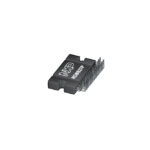 TDF8546ASU/N1ZU
The activity of extra discounts on wholesale prices is in full swing…
Please fill in your contact information and we will send you the latest wholesale price list.






