 ChipApex | Global Electronic Components Supplier
SEARCH
Search Product
Search Post
— IC芯片 | 连接器 | 传感器 | 被动器件 —
Search productSearch post
— IC芯片 | 连接器 | 传感器 | 被动器件 —
Consult the customer manager about the wholesale price.
consultation hotline:86-132-6715-2157
email:[email protected]
Contact the product manager for consultation. One-stop consultation is available.
Do you want a lower wholesale price? Please send us your inquiry and we will reply immediately.
The ULN2068B is a quad Darlington transistor array manufactured by STMicroelectronics, designed to interface logic circuits with high current and high voltage loads. It contains four NPN Darlington switches delivering up to 1.5 A per channel, with a specified minimum breakdown voltage of 50 V and a sustaining voltage of 35 V measured at 100 mA. The device features integral suppression diodes for inductive load protection and common emitters. It includes a pre-driver stage to reduce loading on the control logic. The inputs are compatible with popular 5 V logic families. It is housed in a Power DIP-16 package for through-hole installation, operating within a temperature range of -20°C to 85°C.
Verify the specific manufacturer datasheet for the ULN2068B to confirm electrical characteristics and mechanical dimensions. Ensure compatibility with the target 5 V logic family before integration. Check for any obsolete status or lifecycle changes directly from STMicroelectronics official channels prior to finalizing design-in decisions.
Select the ULN2068B when a pre-driver stage is required to minimize control logic loading. Choose this component over variants like the ULN2064B if the application demands input compatibility specifically with 5 V logic families rather than higher voltage CMOS/PMOS standards. Verify that the 50 V breakdown and 1.5 A current ratings meet the specific load requirements.
The ULN2068B belongs to the ULN20xxB series of quad Darlington switches from STMicroelectronics. This series is engineered for interfacing digital logic with various heavy-duty loads. Unlike the ULN2064B, which lacks a pre-driver, the ULN2068B incorporates this stage to improve drive capability. It shares the common emitter and suppression diode architecture with other members of the family but differs in its specific logic input compatibility profile.
The ULN2064B serves as a functional alternative if the pre-driver stage is not required and the logic interface remains compatible. Designers must verify that the absence of the pre-driver does not overload the controlling circuitry when substituting components.
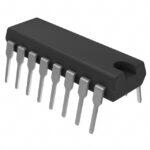 ULN2068B
The activity of extra discounts on wholesale prices is in full swing…
Please fill in your contact information and we will send you the latest wholesale price list.





