 ChipApex | Global Electronic Components Supplier
SEARCH
Search Product
Search Post
— IC芯片 | 连接器 | 传感器 | 被动器件 —
Search productSearch post
— IC芯片 | 连接器 | 传感器 | 被动器件 —
Consult the customer manager about the wholesale price.
consultation hotline:86-132-6715-2157
email:[email protected]
Contact the product manager for consultation. One-stop consultation is available.
Do you want a lower wholesale price? Please send us your inquiry and we will reply immediately.
The ULQ2003ATDQ1 is an automotive-grade high-voltage, high-current Darlington array manufactured by Texas Instruments. It integrates seven open-collector Darlington pairs with common emitters within a single package. Each channel supports a maximum DC collector current of 500 mA and can withstand peak currents up to 600 mA. The device features an output voltage rating of 50 V and includes integrated suppression diodes for inductive load driving. It operates across an extended temperature range from -40°C to +105°C and is qualified according to the AEC-Q100 specification. The inputs are pinned opposite the outputs to facilitate board layout.
Verify component authenticity through authorized distributors or direct manufacturer channels. Confirm the specific suffix indicates the correct automotive grade qualification and SOIC-16 surface-mount packaging. Ensure compliance with RoHS directives and check for any recent production change notices that may affect material composition or assembly origin before finalizing procurement orders.
Select this component when driving inductive loads requiring high voltage isolation and significant current capacity. The integrated flyback diodes eliminate the need for external protection components. Verify that the logic family compatibility matches the control circuitry, as the inputs interface with standard TTL, CMOS, PMOS, and DTL families. Consider thermal management requirements given the power dissipation characteristics of the SOIC-16 package.
This part belongs to the ULQ2003A series of Darlington transistor arrays. It shares functional similarities with commercial variants like the ULN2003 but offers enhanced reliability for automotive environments. The Q1 suffix denotes automotive qualification. It serves as a robust interface between low-power logic controllers and high-power actuators, providing a compact solution for multi-channel switching applications.
Public confirmed substitute part numbers include ULQ2003ADG4 and ULQ2003ADR. Verify pinout compatibility and electrical specifications against the original design requirements before substitution. Ensure the alternative maintains the same automotive qualification status if required by the application.
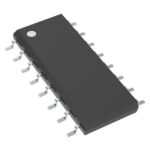 ULQ2003ATDQ1
The activity of extra discounts on wholesale prices is in full swing…
Please fill in your contact information and we will send you the latest wholesale price list.




