 ChipApex | Global Electronic Components Supplier

SEARCH
Search Product
Search Post
— IC芯片 | 连接器 | 传感器 | 被动器件 —
Search productSearch post
— IC芯片 | 连接器 | 传感器 | 被动器件 —
Consult the customer manager about the wholesale price.
consultation hotline:86-132-6715-2157
email:[email protected]
Contact the product manager for consultation. One-stop consultation is available.
Do you want a lower wholesale price? Please send us your inquiry and we will reply immediately.
The Fairchild Semiconductor 2N5366 is a PNP bipolar junction transistor (BJT) designed for switching and amplifier applications. It utilizes silicon technology and is housed in a TO-92-3 through-hole package. Key electrical specifications include a maximum DC collector current of 300 mA, a collector-emitter voltage (VCEO) of 40 V, and a collector-base voltage (VCBO) of 40 V. The device features an emitter-base voltage (VEBO) rating of 4 V and a power dissipation capacity of 625 mW. It operates within a temperature range of -65°C to +150°C and offers a gain-bandwidth product (fT) of 250 MHz.
Verify that the specific procurement lot matches the Fairchild Semiconductor manufacturer designation for the 2N5366 part number. Confirm RoHS compliance status and pinout orientation consistent with the TO-92-3 package specification before integration into designs. Ensure thermal management aligns with the 625 mW power dissipation limit under expected operating conditions.
Select this component when a PNP silicon BJT with moderate current handling and high voltage ratings is required in a through-hole form factor. The 40 V breakdown voltage and 300 mA continuous current capability make it suitable for low-to-medium power applications. Consider the TO-92-3 package constraints for board space and thermal requirements compared to surface-mount alternatives.
The 2N5366 belongs to the broader category of discrete bipolar junction transistors manufactured by Fairchild Semiconductor. As a PNP device, it serves as a fundamental active component in electronic circuits, contrasting with NPN variants in current flow direction. Its classification within the 2N series indicates adherence to established JEDEC-style numbering conventions for silicon transistors.
Cross-reference with other PNP transistors featuring similar VCEO, IC, and package specifications. Verify pin compatibility and electrical characteristics against potential substitutes from different manufacturers to ensure functional equivalence without redesigning the circuit layout.
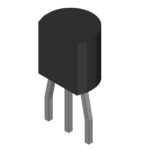 2N5366

The activity of extra discounts on wholesale prices is in full swing…
Please fill in your contact information and we will send you the latest wholesale price list.





