 ChipApex | Global Electronic Components Supplier

SEARCH
Search Product
Search Post
— IC芯片 | 连接器 | 传感器 | 被动器件 —
Search productSearch post
— IC芯片 | 连接器 | 传感器 | 被动器件 —
Consult the customer manager about the wholesale price.
consultation hotline:86-132-6715-2157
email:[email protected]
Contact the product manager for consultation. One-stop consultation is available.
Do you want a lower wholesale price? Please send us your inquiry and we will reply immediately.
The onsemi 2N5400RLRP is a PNP silicon amplifier transistor designed for general-purpose applications. It operates within a collector-emitter voltage range of up to 120 Vdc and supports a continuous collector current of 600 mAdc. The device features a maximum total device dissipation of 625 mW at 25°C ambient temperature, with a thermal resistance junction-to-ambient of 200 °C/W. It functions reliably across an operating and storage junction temperature range of -55°C to +150°C. Packaged in a TO-92 (TO-226) format, this component is supplied in tape and reel configurations containing 2000 units per reel.
Verify the specific ordering suffix RLRP confirms the tape and reel packaging format rather than bulk or ammo pack variants. Ensure the procurement specification aligns with the required quantity increments associated with the reel packaging method. Confirm that the Pb-Free package designation matches environmental compliance requirements if applicable to the final assembly process.
Select this component when a PNP transistor with a 120 V collector-emitter rating and 600 mA continuous current capacity is required. Consider the TO-92 package dimensions for board space constraints and verify that the 625 mW power dissipation limit meets the thermal design requirements. Evaluate the transition frequency characteristics against the intended signal bandwidth needs.
This part belongs to the 2N5400 series of PNP bipolar junction transistors manufactured by onsemi. It serves as a preferred device choice for standard discrete semiconductor applications. The component utilizes a TO-92 case style, providing a compact solution for low-power amplification tasks. It represents a standard industry-compatible alternative for legacy designs utilizing similar NPN/PNP pairs.
Direct substitutes include other PNP transistors with matching 120 V VCEO ratings and TO-92 packages. Verify pinout compatibility and electrical parameters such as hFE gain ranges before substitution. Cross-reference datasheets to ensure thermal resistance and saturation voltage specifications meet the original circuit requirements.
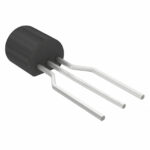 2N5400RLRP

The activity of extra discounts on wholesale prices is in full swing…
Please fill in your contact information and we will send you the latest wholesale price list.




