 ChipApex | Global Electronic Components Supplier

SEARCH
Search Product
Search Post
— IC芯片 | 连接器 | 传感器 | 被动器件 —
Search productSearch post
— IC芯片 | 连接器 | 传感器 | 被动器件 —
Consult the customer manager about the wholesale price.
consultation hotline:86-132-6715-2157
email:[email protected]
Contact the product manager for consultation. One-stop consultation is available.
Do you want a lower wholesale price? Please send us your inquiry and we will reply immediately.
The onsemi 2N6428ABU is an NPN epitaxial silicon transistor housed in a TO-92 package. It features a collector-emitter voltage (VCEO) of 50 V and a collector current (IC) rating of 200 mA. The device supports a maximum power dissipation of 625 mW at 25°C ambient temperature. Key electrical characteristics include a DC current gain (hFE) ranging from 250 to 650, a collector-emitter saturation voltage (VCE(sat)) of 0.2 V at IC=10mA, and a transition frequency (fT) between 100 MHz and 700 MHz.
Verify the datasheet revision date and manufacturer origin, as Fairchild Semiconductor assets were acquired by onsemi. Confirm that the 'A' suffix denotes specific binning or testing criteria if required for your design. Ensure the component matches the TO-92 physical dimensions and pinout configuration specified in the official documentation before integration into the final assembly.
Select this component when a high-gain NPN transistor with moderate voltage ratings is required. The 2N6428ABU offers superior noise performance compared to standard general-purpose transistors. Consider the thermal constraints of the TO-92 package, as the 625 mW dissipation limit requires adequate heat sinking or PCB copper area for sustained operation above room temperature.
This part belongs to the legacy Fairchild Semiconductor 2N series of NPN transistors. Originally designed for audio and linear applications, it remains a standard reference for low-noise amplification. The 2N6428A variant typically represents a tighter specification bin within the broader 2N6428 family, ensuring consistent performance across production batches.
The 2N5088 is explicitly referenced in the datasheet for graphical data comparison and serves as a functional equivalent. Other generic NPN transistors with similar VCEO and hFE ratings may substitute the component, provided the package footprint and pinout compatibility are verified against the target circuit design.
The maximum collector-emitter breakdown voltage (BVCEO) is 50 V.
Yes, the 'A' suffix indicates a specific binning or testing variation, often implying tighter tolerances or different noise figure specifications compared to the base model.
For the 2N6428A, the noise figure is typically 3 dB at 100 Hz with a source resistance of 10 kΩ.
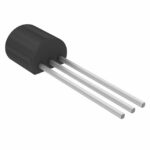 2N6428ABU

The activity of extra discounts on wholesale prices is in full swing…
Please fill in your contact information and we will send you the latest wholesale price list.





