ChipApex | Global Electronic Components Supplier
SEARCH
Search Product
Search Post
— IC芯片 | 连接器 | 传感器 | 被动器件 —
Search productSearch post
— IC芯片 | 连接器 | 传感器 | 被动器件 —
Consult the customer manager about the wholesale price.
consultation hotline:86-132-6715-2157
email:[email protected]
Contact the product manager for consultation. One-stop consultation is available.
Do you want a lower wholesale price? Please send us your inquiry and we will reply immediately.
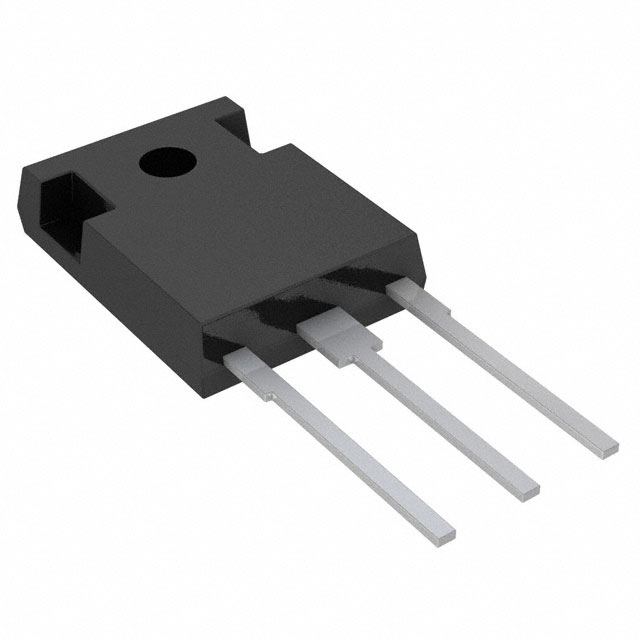
The ARF448BG is an N-channel enhancement mode RF power MOSFET designed for push-pull amplifier applications up to 65 MHz. It features a Drain-Source Breakdown Voltage of 450V and a continuous drain current of 15A at 25°C case temperature. The device delivers 140W output power with 15dB gain and 75% efficiency at 40.68 MHz in Class C operation. Packaged in a TO-247 housing, it exhibits low thermal resistance of 0.55°C/W and operates within a junction temperature range of -55°C to 150°C.
Verify the specific suffix 'G' against the manufacturer's official documentation to confirm if it denotes a specific tape-and-reel packaging variant or environmental compliance status distinct from the standard ARF448B. Ensure the procurement order explicitly references the full part number to avoid confusion with the complementary ARF448A unit required for symmetric push-pull implementation.
Select this component for high-frequency applications operating up to 65 MHz where high breakdown voltage is critical. The 450V rating provides significant margin over the typical 150V supply voltage used in its rated performance tests. Consider the TO-247 package for efficient heat dissipation given the 1.5W thermal resistance, ensuring adequate heatsinking to maintain junction temperatures within the specified operational limits during continuous RF drive.
The ARF448BG belongs to a series of symmetric N-channel RF power transistors manufactured by Advanced Power Technology (APT), now part of Microsemi Corporation. These devices are engineered specifically for common source configurations in radio frequency power amplification. The series includes complementary pairs like the ARF448A and ARF448B, which share identical electrical characteristics but feature mirrored pinouts to facilitate balanced push-pull circuit designs.
The ARF446 and ARF447 are documented as meeting the same electrical specifications as the ARF448 series. They serve as functional substitutes in terms of performance metrics, though their pin-outs are mirror images of each other. Verify mechanical fitment and pin compatibility when substituting these units in existing PCB layouts.
 ARF448BG
The activity of extra discounts on wholesale prices is in full swing…
Please fill in your contact information and we will send you the latest wholesale price list.