ChipApex | Global Electronic Components Supplier
SEARCH
Search Product
Search Post
— IC芯片 | 连接器 | 传感器 | 被动器件 —
Search productSearch post
— IC芯片 | 连接器 | 传感器 | 被动器件 —
Consult the customer manager about the wholesale price.
consultation hotline:86-132-6715-2157
email:[email protected]
Contact the product manager for consultation. One-stop consultation is available.
Do you want a lower wholesale price? Please send us your inquiry and we will reply immediately.
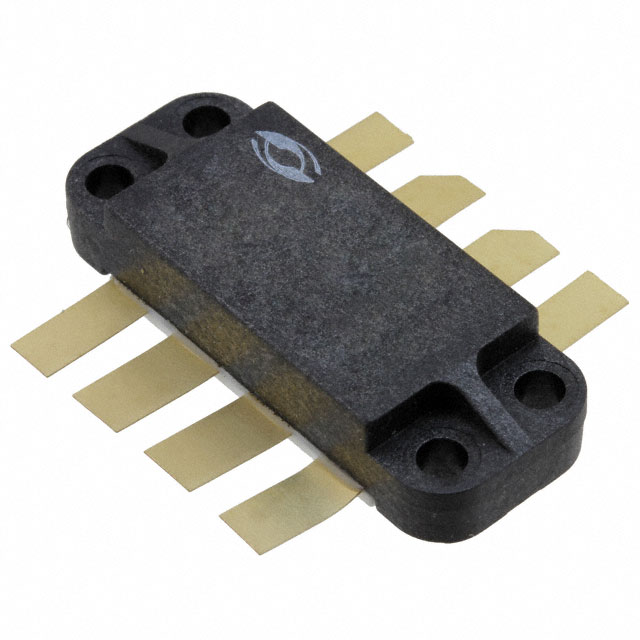
The ARF473 is a matched pair of N-channel enhancement mode RF power MOSFETs designed for high-voltage push-pull or parallel operation in narrowband ISM and MRI power amplifiers up to 150 MHz. It features a common source configuration with a total device dissipation of 500 Watts at 25°C case temperature. The device provides a drain-source breakdown voltage of 500 Volts and continuous drain current of 10 Amps per device. In Class AB operation at 130 MHz, it delivers 300 Watts output power with 13 dB gain and 50% efficiency.
Verify the specific revision status against the datasheet document identifier 050-4920 Rev C dated June 2003. Confirm that the package contains beryllium oxide ceramic; strict handling protocols are required to prevent inhalation of toxic dust during mounting or mechanical processing. Ensure electrostatic discharge precautions are implemented during storage and installation.
Select this component for applications requiring matched dual transistors in high-voltage RF environments up to 150 MHz. The device is suitable for designs needing 300 Watts output capability with low thermal impedance. Consider the physical dimensions and flange mounting requirements when designing the heatsink interface. Verify compatibility with the specified gate drive voltages and biasing networks for the intended frequency band.
This part belongs to the family of RF power MOSFETs manufactured by Advanced Power Technology (APT), now part of Microsemi Corporation. These devices are engineered specifically for radio frequency power amplification tasks where high voltage tolerance and thermal management are critical. The ARF473 utilizes a specialized package to facilitate push-pull topology implementation.
No public confirmed substitute part numbers are available in the provided documentation.
The device exhibits electrical ruggedness capable of sustaining a VSWR of 5:1 for one pulse test without degradation in output power.
The ceramic portion of the device between the leads and the mounting flange contains beryllium oxide, which is highly toxic if inhaled as dust.
The typical forward transconductance is 46 mhos, measured at VDS = 25V and ID = 5A.
 ARF473
The activity of extra discounts on wholesale prices is in full swing…
Please fill in your contact information and we will send you the latest wholesale price list.