 ChipApex | Global Electronic Components Supplier

SEARCH
Search Product
Search Post
— IC芯片 | 连接器 | 传感器 | 被动器件 —
Search productSearch post
— IC芯片 | 连接器 | 传感器 | 被动器件 —
Consult the customer manager about the wholesale price.
consultation hotline:86-132-6715-2157
email:[email protected]
Contact the product manager for consultation. One-stop consultation is available.
Do you want a lower wholesale price? Please send us your inquiry and we will reply immediately.
BC548CBU is listed in the Single Bipolar Transistors range at ChipApex. The manufacturer field lists onsemi. Its product description is TRANS NPN 30V 0.1A TO-92-3. Review the specifications below when checking this part for your BOM.
The BC548CBU is an NPN silicon epitaxial planar transistor from the onsemi BC548 series, housed in a TO-92 (TO-226AA) through-hole package. It features a maximum collector-emitter voltage of 30V and a continuous collector current of 100mA. The device offers a DC current gain (hFE) range of 200 to 450 at IC=2mA and VCE=5V. Key electrical limits include a collector-base voltage of 30V, emitter-base voltage of 5V, power dissipation of 500mW, and a transition frequency of 300MHz. The junction temperature rating extends up to +150°C.
Verify the specific suffix 'BU' against the official onsemi datasheet to confirm packaging details, as standard BC548C devices may use different tape-and-reel or ammo pack configurations. Ensure the hFE binning matches the required circuit gain specifications. Confirm RoHS compliance status directly with the manufacturer documentation for the specific batch code.
Select this component when a high-gain NPN transistor is required for low-noise amplification. The BC548C variant provides a tighter gain tolerance compared to A or B grades. Consider the complementary BC558C PNP device for matched pairs. Verify that the 30V voltage rating and 100mA current limit are sufficient for the target application load.
The BC548 series comprises NPN general-purpose transistors widely used in consumer and industrial electronics. The BC548C specifically denotes a higher gain bin within the family. These devices are standard replacements for older 2N3904 equivalents in many low-power designs, offering comparable performance with distinct gain characteristics defined by the manufacturer's grading system.
BC548C equivalent parts from other manufacturers such as Fairchild or Diotec offer pin-compatible alternatives. Verify that substitute components meet the same 30V VCEO and 100mA IC ratings. Check if the replacement maintains the 200-450 hFE range to ensure circuit stability without modification.
Explore related parts through Bipolar (BJT), Transistors, Discrete Semiconductor Products, all product categories.
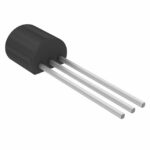 BC548CBU

The activity of extra discounts on wholesale prices is in full swing…
Please fill in your contact information and we will send you the latest wholesale price list.





