 ChipApex | Global Electronic Components Supplier
SEARCH
Search Product
Search Post
— IC芯片 | 连接器 | 传感器 | 被动器件 —
Search productSearch post
— IC芯片 | 连接器 | 传感器 | 被动器件 —
Consult the customer manager about the wholesale price.
consultation hotline:86-132-6715-2157
email:[email protected]
Contact the product manager for consultation. One-stop consultation is available.
Do you want a lower wholesale price? Please send us your inquiry and we will reply immediately.
The BC857BS-QX is a dual PNP bipolar junction transistor (BJT) manufactured by Nexperia. It is housed in a SOT363 (SC-88) surface-mount package with six pins. The device features a maximum collector-emitter voltage (VCEO) of 45 V and a continuous collector current of -100 mA. Key electrical parameters include a collector-base voltage (VCBO) of 50 V, an emitter-base voltage (VEBO) of 5 V, and a power dissipation (Pd) of 300 mW. The component has a transition frequency (fT) of 175 MHz and a minimum DC current gain (hFE) of 200. It operates within a temperature range of -65 °C to +150 °C and holds AEC-Q101 automotive qualification.
Verify that the specific suffix '-QX' corresponds to the required AEC-Q101 automotive qualification status as defined in official Nexperia documentation. Confirm the package type is SOT363 (SC-88) and ensure the ordering code matches the exact pinout and specifications required for the target design. Cross-reference with authorized distributors to validate authenticity and supply chain integrity.
Select this component when a dual PNP transistor with automotive certification is required in a small form factor. It serves as the complement to the NPN/NPN BC847BS-QX. Ensure the design accommodates the 300 mW power dissipation limit and the 45 V voltage rating. Consider the 175 MHz bandwidth for high-speed switching needs compared to lower-frequency alternatives.
This part belongs to the BC857 series of small-signal PNP transistors from Nexperia. It is specifically the dual-transistor variant packaged in SOT363, distinct from single-transistor versions like the BC857B or BC857AW. The 'Q' suffix indicates compliance with automotive quality standards, differentiating it from standard commercial grade parts.
The BC857BS is the direct functional complement to the BC847BS-QX. For single-channel replacements, consider the BC857B or BC857AW, though these lack the dual configuration and may differ in package dimensions and thermal characteristics.
The maximum operating temperature is +150 °C.
Yes, the component is qualified according to the AEC-Q101 standard for stress test qualification of integrated circuits.
It is housed in a SOT363 (also known as SC-88) surface-mount plastic package.
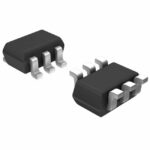 BC857BS-QX
The activity of extra discounts on wholesale prices is in full swing…
Please fill in your contact information and we will send you the latest wholesale price list.





