 ChipApex | Global Electronic Components Supplier
SEARCH
Search Product
Search Post
— IC芯片 | 连接器 | 传感器 | 被动器件 —
Search productSearch post
— IC芯片 | 连接器 | 传感器 | 被动器件 —
Consult the customer manager about the wholesale price.
consultation hotline:86-132-6715-2157
email:[email protected]
Contact the product manager for consultation. One-stop consultation is available.
Do you want a lower wholesale price? Please send us your inquiry and we will reply immediately.
The BCP51-10,135 is a PNP medium power transistor from the Nexperia BCP51 series, housed in an SOT223 (SC-73) plastic surface-mounted package. It features a collector-emitter voltage of -45 V and a continuous collector current of -1 A. The device supports a peak collector current of -2 A for single pulses up to 1 ms. Total power dissipation reaches 1.35 W on an FR4 PCB with a 6 cm² collector pad. The junction temperature range spans from -55 °C to +150 °C. This specific variant includes an hFE selection of -10, providing a DC current gain between 63 and 160 at IC = -150 mA.
Verify the ordering suffix matches the required tape and reel specification. Confirm the hFE bin corresponds to the -10 selection group. Ensure the package type aligns with the SOT223 footprint requirements. Check the most recent datasheet revision for any updates to limiting values or thermal characteristics before finalizing the design.
Select this component when a PNP transistor with high current handling and robust thermal performance is required. The exposed metal pad facilitates efficient heat transfer to the PCB copper area. Consider the specific hFE bin to ensure consistent gain across production batches. Evaluate the power derating curves based on the intended PCB layout and ambient temperature conditions.
This part belongs to the BCP51 series of PNP medium power transistors manufactured by Nexperia. The series includes variants in different packages such as SOT89 and SOT1061. The BCP51 specifically utilizes the SOT223 package, offering a balance between power handling and compact surface-mount integration. It serves as a complement to NPN counterparts like the BCP54.
BCP51-10
For the hFE selection -10, the DC current gain ranges from 63 to 160 when measured at a collector current of -150 mA and VCE = -2 V.
The SOT223 package includes an exposed heatsink that provides excellent thermal and electrical conductivity, allowing for higher power dissipation when mounted on a PCB with adequate copper area.
Yes, the product has been qualified in accordance with the Automotive Electronics Council (AEC) standard Q101, making it suitable for use in automotive applications.
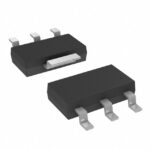 BCP51-10,135
The activity of extra discounts on wholesale prices is in full swing…
Please fill in your contact information and we will send you the latest wholesale price list.





