 ChipApex | Global Electronic Components Supplier
SEARCH
Search Product
Search Post
— IC芯片 | 连接器 | 传感器 | 被动器件 —
Search productSearch post
— IC芯片 | 连接器 | 传感器 | 被动器件 —
Consult the customer manager about the wholesale price.
consultation hotline:86-132-6715-2157
email:[email protected]
Contact the product manager for consultation. One-stop consultation is available.
Do you want a lower wholesale price? Please send us your inquiry and we will reply immediately.
The BCP5616TTC is an NPN medium power transistor manufactured by Diodes Incorporated, housed in a SOT223 surface-mount package. It features a collector-emitter breakdown voltage (BVCEO) of 80V and supports a continuous collector current (IC) of 1A with a peak pulse current (ICM) of 2A. The device offers a maximum power dissipation of 2.5W at 25°C ambient temperature and maintains a low saturation voltage (VCE(sat)) below 500mV at 0.5A. Transition frequency (fT) reaches 150MHz, while the static forward current transfer ratio (hFE) ranges from 63 to 400 depending on operating conditions.
Verify that the specific ordering suffix matches the required packaging quantity. The TTC suffix indicates a tape and reel configuration containing 4,000 units per 13-inch reel. Confirm compliance requirements such as automotive qualification if applicable, as standard parts differ from AEC-Q100 qualified variants. Ensure storage conditions adhere to moisture sensitivity level 1 standards prior to soldering.
Select this component when high current handling and low saturation voltage are critical for efficiency. The SOT223 package provides adequate thermal dissipation for medium power tasks without requiring excessive board space. Consider the transition frequency specifications for signal amplification needs. Verify that the 80V rating aligns with the circuit's maximum voltage stress levels under all operating conditions.
This part belongs to the BCP56 series of NPN medium power transistors designed for general-purpose switching and amplification. It serves as a complementary counterpart to PNP types within the same family. The device utilizes a molded plastic case with a UL flammability rating of 94V-0. It is intended for surface mounting on printed circuit boards using standard reflow soldering techniques.
Direct substitutes include other NPN transistors with matching 80V ratings and 1A continuous current capabilities in SOT223 packages. Verify pinout compatibility and thermal resistance values before substitution. Complementary PNP devices may be required for push-pull configurations.
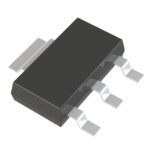 BCP5616TTC
The activity of extra discounts on wholesale prices is in full swing…
Please fill in your contact information and we will send you the latest wholesale price list.





