 ChipApex | Global Electronic Components Supplier
SEARCH
Search Product
Search Post
— IC芯片 | 连接器 | 传感器 | 被动器件 —
Search productSearch post
— IC芯片 | 连接器 | 传感器 | 被动器件 —
Consult the customer manager about the wholesale price.
consultation hotline:86-132-6715-2157
email:[email protected]
Contact the product manager for consultation. One-stop consultation is available.
Do you want a lower wholesale price? Please send us your inquiry and we will reply immediately.
The DMC62D0SVQ-13 is a dual-channel MOSFET array manufactured by Diodes Incorporated, featuring both N-Channel and P-Channel enhancement mode transistors within a single SOT-563-6 surface-mount package. Designed for silicon technology, this component supports a drain-source breakdown voltage range of 50 V to 60 V and operates across an extended temperature range from -55°C to +150°C. It carries AEC-Q101 qualification for automotive reliability. Key electrical parameters include continuous drain currents of 304 mA and 571 mA, on-resistances of 1.7 Ohms and 6 Ohms, and gate charges of 400 pC and 300 pC respectively. The device dissipates up to 840 mW with a maximum gate-source voltage of ±20 V.
Verify the specific suffix against official Diodes Incorporated documentation to confirm exact electrical tolerances and packaging variations. Ensure the procurement source provides valid traceability for AEC-Q101 qualified components intended for automotive or industrial use. Cross-reference the datasheet revision date to guarantee parameter accuracy during integration.
Select this component when a compact dual-switch solution is required for low-current applications. The SOT-563-6 package minimizes board space compared to discrete alternatives. Evaluate the combined on-resistance and gate charge specifications against the target switching frequency and drive capability requirements to ensure efficient performance within the specified thermal limits.
This part belongs to the DMC series of dual MOSFET arrays produced by Diodes Incorporated. The series offers various combinations of N-Channel and P-Channel devices optimized for different voltage and current ratings. The DMC62D0SVQ variant specifically targets automotive and industrial markets with its robust qualification and wide temperature range capabilities.
Consult official substitution guides for compatible parts such as the DMC62D0SVQ-7, noting that suffix changes may indicate differences in reel packaging quantities rather than functional alterations. Verify pinout compatibility and electrical parameter equivalence before implementing any alternative component in existing designs.
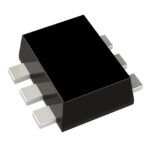 DMC62D0SVQ-13
The activity of extra discounts on wholesale prices is in full swing…
Please fill in your contact information and we will send you the latest wholesale price list.





