 ChipApex | Global Electronic Components Supplier

SEARCH
Search Product
Search Post
— IC芯片 | 连接器 | 传感器 | 被动器件 —
Search productSearch post
— IC芯片 | 连接器 | 传感器 | 被动器件 —
Consult the customer manager about the wholesale price.
consultation hotline:86-132-6715-2157
email:[email protected]
Contact the product manager for consultation. One-stop consultation is available.
Do you want a lower wholesale price? Please send us your inquiry and we will reply immediately.
The DMS3019SSD-13 is an asymmetric dual N-channel enhancement mode MOSFET in an SO-8 package. It integrates a Schottky diode on one die (Q2) and a standard MOSFET on the other (Q1). Q1 features a 30V drain-source voltage, 7.0A continuous current at 25°C, and 10mΩ on-resistance. Q2 offers 30V breakdown, 5.7A current, and 15mΩ resistance. The device supports -55°C to +150°C operation, utilizes avalanche-rated technology, and meets AEC-Q101 standards.
Verify component authenticity through authorized Diodes Incorporated channels. Confirm the specific ordering suffix matches the required tape and reel packaging quantity. Ensure compliance with RoHS and halogen-free definitions if environmental specifications are mandatory for the assembly process.
Select this component when asymmetric dual-channel performance is required. Compare the distinct on-resistance and current ratings between Q1 and Q2 against circuit load requirements. Evaluate the integrated Schottky benefits for reverse recovery reduction versus discrete solutions.
This part belongs to the DMS series of asymmetric dual MOSFETs from Diodes Incorporated. It is designed for compact power solutions where space efficiency and reduced switching losses are critical. The SO-8 case provides a balance of thermal performance and footprint size for surface mount applications.
The datasheet explicitly states 'NOT RECOMMENDED FOR NEW DESIGN' and 'NO ALTERNATE PRODUCT'. No verified substitute part numbers are available in official documentation.
Q1 is a standard N-channel MOSFET with lower on-resistance and higher current capability. Q2 is an N-channel MOSFET monolithically integrated with a Schottky diode, featuring different threshold voltages and slightly higher on-resistance.
Yes, the device is qualified to AEC-Q101 standards for high reliability, making it suitable for automotive power management applications.
The integrated Schottky diode on Q2 reduces reverse recovery charge (Qrr), which lowers body diode switching losses and minimizes the risk of shoot-through currents at high frequencies.
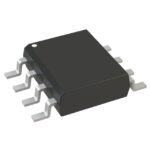 DMS3019SSD-13

The activity of extra discounts on wholesale prices is in full swing…
Please fill in your contact information and we will send you the latest wholesale price list.





