ChipApex | Global Electronic Components Supplier
SEARCH
Search Product
Search Post
— IC芯片 | 连接器 | 传感器 | 被动器件 —
Search productSearch post
— IC芯片 | 连接器 | 传感器 | 被动器件 —
Consult the customer manager about the wholesale price.
consultation hotline:86-132-6715-2157
email:[email protected]
Contact the product manager for consultation. One-stop consultation is available.
Do you want a lower wholesale price? Please send us your inquiry and we will reply immediately.
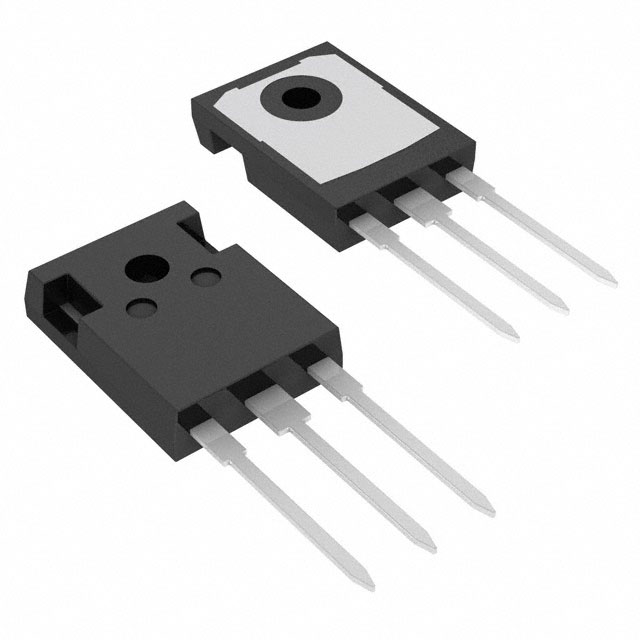
The onsemi FGH50N3 is a planar technology N-channel Insulated Gate Bipolar Transistor (IGBT) designed for high-frequency switching applications requiring low conduction losses. It features a maximum collector-emitter voltage of 300 V and a continuous collector current of 75 A at 25°C case temperature. The device operates within a junction temperature range of -55°C to +150°C and is housed in a TO-247-3LD short lead package with flange mount installation.
Verify the specific ordering suffix against official documentation, as variations may exist. Confirm that the component meets RoHS compliance standards if required by your manufacturing process. Ensure thermal management solutions are compatible with the TO-247-3LD package dimensions and mounting requirements specified in the datasheet.
Select this IGBT when designing circuits operating at medium frequencies where minimizing conduction losses is critical. Consider the 300 V breakdown voltage and 75 A current rating to ensure adequate headroom for your application's peak loads. Evaluate the thermal resistance characteristics to determine appropriate heatsinking for sustained operation.
This component belongs to onsemi's discrete IGBT portfolio, specifically engineered for high-voltage switching. It utilizes planar technology to achieve performance metrics suitable for modern power electronics. The device is distinct from MOSFETs due to its bipolar conduction mechanism, offering lower on-state voltage drops at higher currents.
When substituting this part, verify that the replacement device matches the 300 V collector-emitter voltage rating and provides comparable continuous current capabilities. Ensure the new component fits the TO-247-3LD footprint and maintains similar switching speed characteristics to preserve circuit timing and efficiency.
The device has a short circuit withstand time of 8 microseconds at a junction temperature of 125°C.
Yes, the collector-emitter saturation voltage exhibits a positive temperature coefficient above 50 A, which aids in parallel operation.
The turn-off energy loss is optimized to be approximately 6.6 microjoules per ampere under standard test conditions.
 FGH50N3
The activity of extra discounts on wholesale prices is in full swing…
Please fill in your contact information and we will send you the latest wholesale price list.