 ChipApex | Global Electronic Components Supplier
SEARCH
Search Product
Search Post
— IC芯片 | 连接器 | 传感器 | 被动器件 —
Search productSearch post
— IC芯片 | 连接器 | 传感器 | 被动器件 —
Consult the customer manager about the wholesale price.
consultation hotline:86-132-6715-2157
email:[email protected]
Contact the product manager for consultation. One-stop consultation is available.
Do you want a lower wholesale price? Please send us your inquiry and we will reply immediately.
The HFA3128B96 is an ultra-high frequency transistor array fabricated using Intersil’s complementary bipolar UHF-1 process. The device integrates five dielectrically isolated transistors on a common monolithic substrate, featuring NPN and PNP types with transition frequencies of 8 GHz and 5.5 GHz, respectively. It exhibits a noise figure of 3.5 dB at 1.0 GHz in a 50 Ω system. Key electrical parameters include an NPN current gain (hFE) of 130, an NPN Early voltage of 50 V, and a collector-to-collector leakage current of less than 1 pA. The package is a 14-pin SOIC.
Verify RoHS compliance status as the suffix '96' indicates lead-free plus anneal availability. Confirm manufacturer origin, as production may be attributed to Renesas Electronics following corporate acquisitions. Ensure datasheet revision matches the specific manufacturing lot requirements for your application.
Select this component when designing circuits requiring matched NPN and PNP pairs with low noise characteristics at VHF/UHF frequencies. Consider the 14-pin SOIC package constraints and thermal dissipation capabilities. Verify that the 8 GHz NPN transition frequency meets the specific signal processing bandwidth requirements of the target system.
This part belongs to the HFA3046, HFA3096, HFA3127, and HFA3128 family of ultra-high frequency transistor arrays. These components share similar fabrication processes and functional architectures, differing primarily in specific transistor configurations or packaging options. They are designed for high-performance RF signal processing tasks.
Direct pin-compatible replacements include other members of the 3XXX series arrays. Verify electrical parameter equivalence, particularly transition frequency and noise figure, before substituting with alternative manufacturers' offerings.
The NPN transistors exhibit a transition frequency (fT) of 8 GHz.
Yes, the device features complete isolation between transistors due to its dielectrically isolated construction on a common monolithic substrate.
The noise figure is 3.5 dB at 1.0 GHz in a 50 Ω system.
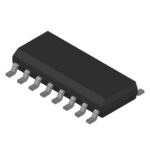 HFA3128B96
The activity of extra discounts on wholesale prices is in full swing…
Please fill in your contact information and we will send you the latest wholesale price list.







