 ChipApex | Global Electronic Components Supplier
SEARCH
Search Product
Search Post
— IC芯片 | 连接器 | 传感器 | 被动器件 —
Search productSearch post
— IC芯片 | 连接器 | 传感器 | 被动器件 —
Consult the customer manager about the wholesale price.
consultation hotline:86-132-6715-2157
email:[email protected]
Contact the product manager for consultation. One-stop consultation is available.
Do you want a lower wholesale price? Please send us your inquiry and we will reply immediately.
The MAVR-045446-0287AT is a silicon abrupt tuning varactor diode from the MAVR-0454xx series, designed for general-purpose tuning in HF to UHF frequency bands. It features a single configuration housed in an SOT-23 surface mount package with parasitics of 0.12 pF capacitance and 1.3 nH inductance. Electrical specifications at +25°C include a minimum breakdown voltage of 30 V at 10 mA reverse current and a maximum reverse leakage current of 100 nA at 24 V. The device exhibits a nominal total capacitance of 33 pF (range 29.7–36.3 pF), a typical capacitance ratio of 4.7, and a minimum Q factor of 750 measured at 4 V and 1 MHz.
Verify the specific ordering suffix against official MACOM documentation to confirm the exact package style, internal configuration, and packaging format. Confirm RoHS compliance status and lead times directly with authorized distributors or the manufacturer prior to placing orders.
Select this component when consistent performance across production lots is required for HF through UHF applications. Ensure the design accommodates the specified absolute maximum ratings, particularly the 30 V reverse voltage limit and thermal constraints during reflow soldering.
This part belongs to the MAVR-0454xx Series of silicon abrupt tuning varactors. The series provides cost-effective surface mount solutions available in SOT-23 and SOT-323 packages, offering various capacitance values tailored for different tuning requirements within the same manufacturing platform.
Other parts in the MAVR-0454xx series, such as the MAVR-045441-0287AT or MAVR-045448-0287AT, share identical package dimensions and mounting parameters but differ in capacitance values and Q factors.
The minimum Q factor of 750 is specified at a reverse voltage of 4 V and a frequency of 1 MHz.
The device supports an operating temperature range from -55°C to +125°C.
It utilizes an SPC (Statistical Process Control) process combined with UHCVD/ion-implanted silicon technology to ensure superior consistency in capacitance and quality factor variations.
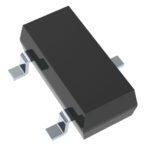 MAVR-045446-0287AT
The activity of extra discounts on wholesale prices is in full swing…
Please fill in your contact information and we will send you the latest wholesale price list.





