 ChipApex | Global Electronic Components Supplier
SEARCH
Search Product
Search Post
— IC芯片 | 连接器 | 传感器 | 被动器件 —
Search productSearch post
— IC芯片 | 连接器 | 传感器 | 被动器件 —
Consult the customer manager about the wholesale price.
consultation hotline:86-132-6715-2157
email:[email protected]
Contact the product manager for consultation. One-stop consultation is available.
Do you want a lower wholesale price? Please send us your inquiry and we will reply immediately.
The MMBFJ176 is a P-Channel Junction Field Effect Transistor (JFET) manufactured by onsemi. It is designed for low-level analog switching applications, including sample-and-hold circuits and chopper-stabilized amplifiers. The device is available in SOT-23 (TO-236) surface-mount packaging. Key electrical characteristics include a Gate-Source Breakdown Voltage of 30 V, a Gate-Source Cut-Off Voltage range of 1.0 V to 4.0 V, and a Zero-Gate Voltage Drain Current range of -2.0 mA to -25.0 mA at VDS = -15 V. The maximum total device dissipation is 225 mW, with an operating junction temperature range from -55 °C to +150 °C.
Verify the specific package variant required, as the J176 series includes both TO-92 and SOT-23 configurations. Confirm that the ordering suffix matches the desired packing method, such as tape and reel for the MMBFJ176. Ensure compatibility with the target PCB land pattern size, particularly for the SOT-23 footprint. Check for any recent product change notifications regarding manufacturing site or material composition updates.
Select the MMBFJ176 when a P-Channel JFET with moderate drain current capability and low gate leakage is required for analog signal paths. Consider the specific VGS(off) binning if precise cutoff voltage control is necessary for the application. Evaluate thermal constraints carefully, as the SOT-23 package has a lower power dissipation rating compared to through-hole alternatives. Verify that the 30 V breakdown voltage meets the circuit's peak voltage requirements.
The MMBFJ176 belongs to the J175/J176/J177 family of P-Channel Switches produced by onsemi. This family shares similar functional descriptions but may vary in specific electrical parameter ranges or physical packaging options. The component is part of onsemi's broader portfolio of discrete semiconductors used in industrial, consumer, and automotive electronics markets.
Direct substitutes within the same family include the J176 (TO-92 package). Other P-Channel JFETs in the MMBFJ series may serve as functional replacements if pinout and electrical parameters align, though specific Idss and VGS(off) ranges must be verified against the new component's datasheet.
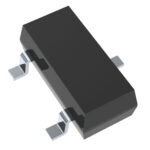 MMBFJ176
The activity of extra discounts on wholesale prices is in full swing…
Please fill in your contact information and we will send you the latest wholesale price list.






