ChipApex | Global Electronic Components Supplier
SEARCH
Search Product
Search Post
— IC芯片 | 连接器 | 传感器 | 被动器件 —
Search productSearch post
— IC芯片 | 连接器 | 传感器 | 被动器件 —
Consult the customer manager about the wholesale price.
consultation hotline:86-132-6715-2157
email:[email protected]
Contact the product manager for consultation. One-stop consultation is available.
Do you want a lower wholesale price? Please send us your inquiry and we will reply immediately.
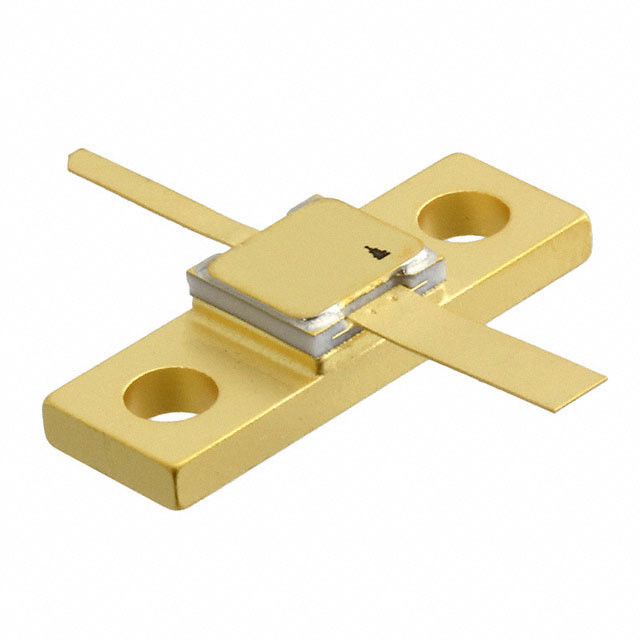
The MRF10005 is a microwave power silicon bipolar transistor designed for continuous wave and long-pulsed common base amplifier applications. It operates within the 960 to 1215 MHz frequency range with a maximum voltage rating of 28Vdc. The device guarantees an output power of 5.0W CW at 1.215GHz, achieving a minimum gain of 8.5dB and a typical gain of 10.3dB. It features internal input matching for broadband operation and is hermetically sealed in an industry-standard package.
Verify the specific datasheet revision (e.g., Rev. V1) against the manufacturer's official documentation before procurement. Confirm that the component meets all absolute maximum ratings and operational conditions required by the target circuit design. Ensure compatibility with the specified frequency range and voltage levels during the sourcing process.
Select this component for designs requiring high overall duty cycles in the 0.96 to 1.215 GHz band. Evaluate thermal management requirements based on the 5.0W CW output capability. Consider the 28Vdc operating voltage when designing bias networks. Verify load mismatch tolerance specifications if the application involves variable impedance environments.
This part belongs to MACOM's portfolio of microwave power silicon bipolar transistors. It is engineered specifically for robust performance in demanding RF environments. The device utilizes gold metallization and emitter ballasting to ensure longevity and resistance to metal migration under high-power conditions.
Consult MACOM technical support for verified substitute part numbers. Do not assume cross-compatibility with other manufacturers' devices without validating pinouts, electrical parameters, and package dimensions against the official datasheet.
The MRF10005 guarantees an output power of 5.0W CW at 1.215GHz with a 28Vdc supply.
No, MACOM products are not intended for use in medical, lifesaving, or life-sustaining applications.
It uses a hermetically sealed industry standard package (CASE 336E-02, STYLE 1).
 MRF10005
The activity of extra discounts on wholesale prices is in full swing…
Please fill in your contact information and we will send you the latest wholesale price list.