ChipApex | Global Electronic Components Supplier
SEARCH
Search Product
Search Post
— IC芯片 | 连接器 | 传感器 | 被动器件 —
Search productSearch post
— IC芯片 | 连接器 | 传感器 | 被动器件 —
Consult the customer manager about the wholesale price.
consultation hotline:86-132-6715-2157
email:[email protected]
Contact the product manager for consultation. One-stop consultation is available.
Do you want a lower wholesale price? Please send us your inquiry and we will reply immediately.
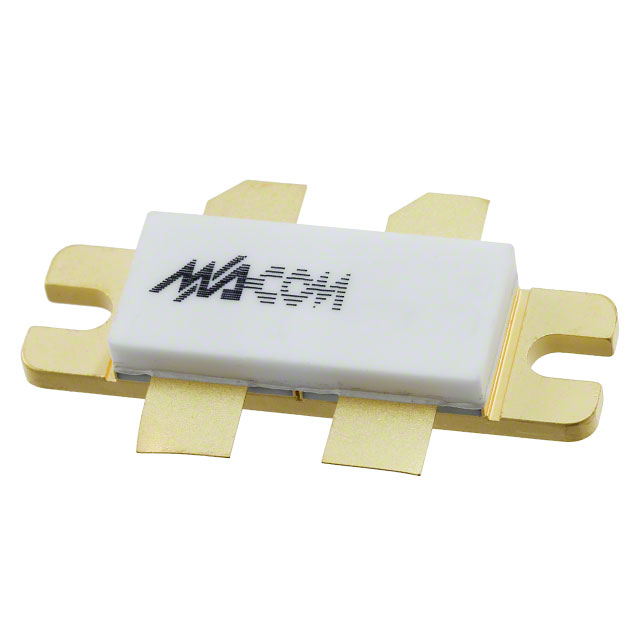
The MRF175GU is an N-channel enhancement mode RF MOSFET designed for broadband commercial and military applications. It operates at frequencies up to 500 MHz with a rated drain voltage of 28 V. The device delivers 200 W output power and 14 dB typical power gain at 225 MHz, achieving 65% typical efficiency. It features low reverse transfer capacitance (Crss) of 20 pF typ at VDS = 28 V and is ruggedness tested at rated output power.
Verify the specific suffix 'U' against official MACOM documentation to confirm package style and testing requirements. Ensure compatibility with push-pull circuit designs operating within the specified 28 V and 500 MHz limits. Confirm that gate protection circuits are included if external zener diodes are required, as the device lacks internal monolithic protection.
Select this component for HF, VHF, and UHF power amplifier applications requiring high gain and simple bias systems. The enhancement mode operation allows for easy DC control of power output via gate voltage variation. Consider the positive temperature coefficient of on-resistance for high-temperature design considerations.
The MRF175G series includes RF power N-channel enhancement mode field-effect transistors featuring a vertical structure with a planar design. These devices are part of MACOM's portfolio of RF MOSFETs characterized by relative immunity to thermal runaway and the ability to vary power output over a wide range using a low power DC control signal.
Consult official MACOM datasheets for direct substitutes such as the MRF175GV. Verify that any replacement maintains the required 200 W output power, 28 V rating, and 500 MHz frequency capability for the intended application.
No, these devices do not have an internal monolithic zener diode from gate-to-source. An external zener diode is recommended if gate protection is required.
Power output may be controlled from its rated value down to zero by varying the DC gate voltage, facilitating manual gain control and modulation systems.
The device was characterized at IDQ = 100 mA per side, which is the suggested minimum value for optimal performance.
 MRF175GU
The activity of extra discounts on wholesale prices is in full swing…
Please fill in your contact information and we will send you the latest wholesale price list.