 ChipApex | Global Electronic Components Supplier
SEARCH
Search Product
Search Post
— IC芯片 | 连接器 | 传感器 | 被动器件 —
Search productSearch post
— IC芯片 | 连接器 | 传感器 | 被动器件 —
Consult the customer manager about the wholesale price.
consultation hotline:86-132-6715-2157
email:[email protected]
Contact the product manager for consultation. One-stop consultation is available.
Do you want a lower wholesale price? Please send us your inquiry and we will reply immediately.
The MRF6V12500HSR5 is a pulsed lateral N-Channel RF Power LDMOS transistor manufactured by NXP Semiconductors. It operates within the 960 MHz to 1215 MHz frequency range and delivers a peak output power of 500 W at a drain-source voltage of 50 V. The device features an NI-780S-2L package with screw mount installation. Key electrical parameters include a drain-source breakdown voltage of 110 V, a maximum operating junction temperature of 225 °C, and a thermal impedance from junction to case of 0.044 °C/W under specified pulse conditions.
Verify the specific ordering suffix 'SR5' against the manufacturer's current documentation to confirm the tape and reel specifications, including unit count and tape width. Ensure that the NI-780S-2L package variant matches the mechanical requirements of the intended assembly process. Cross-reference the part number with the latest datasheet revision to confirm active status and any potential obsolescence notices before finalizing procurement plans.
Select this component for high-power pulsed applications requiring internal matching within the 960–1215 MHz band. Consider the 500 W peak power capability and 50 V operating voltage when designing the bias network. Evaluate the thermal management requirements based on the specified junction-to-case thermal impedance. Verify that the system can accommodate the integrated ESD protection characteristics and the extended negative gate-source voltage range for optimal Class C performance.
This device belongs to the MRF6V12500H series of RF power LDMOS transistors designed specifically for pulsed operations in the aviation radar spectrum. The HS variant utilizes the NI-780S-2L package, which differs mechanically from the standard H package. These transistors are engineered to provide robust performance in critical air traffic control infrastructure, ensuring reliable signal transmission and reception in demanding environmental conditions.
Consult the official datasheet for confirmed substitute part numbers. No direct substitutes are explicitly listed in the provided documentation.
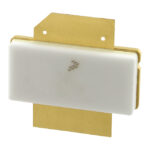 MRF6V12500HSR5
The activity of extra discounts on wholesale prices is in full swing…
Please fill in your contact information and we will send you the latest wholesale price list.





