 ChipApex | Global Electronic Components Supplier
SEARCH
Search Product
Search Post
— IC芯片 | 连接器 | 传感器 | 被动器件 —
Search productSearch post
— IC芯片 | 连接器 | 传感器 | 被动器件 —
Consult the customer manager about the wholesale price.
consultation hotline:86-132-6715-2157
email:[email protected]
Contact the product manager for consultation. One-stop consultation is available.
Do you want a lower wholesale price? Please send us your inquiry and we will reply immediately.
The NE68133-T1B-R35-A is an NPN epitaxial silicon high-frequency transistor from the CEL NE681 series, packaged in a Micro-X (35) surface mount style. It is designed for low noise and high gain amplifier applications up to 4 GHz. Key electrical characteristics include a gain bandwidth product of 9.0 GHz at VCE = 8 V, IC = 20 mA. Noise figure specifications are 1.2 dB minimum at 1 GHz and 1.6 dB minimum at 2 GHz under VCE = 8 V, IC = 7 mA conditions. Associated gain reaches 13.5 dB at 1 GHz and 12 dB at 2 GHz. The device supports a collector current of up to 65 mA with a total power dissipation of 200 mW.
Verify component authenticity by checking manufacturer markings against official datasheet specifications. Confirm package outline matches the Micro-X (35) designation. Ensure the part meets the required AEC-Q100 qualification if automotive application is intended, as standard NE681 series parts may not carry this rating unless specified. Request batch traceability documentation upon order placement.
Select this component when designing amplifiers requiring simultaneous low noise figure and high gain in the microwave frequency range. Consider the Micro-X package for compact surface mount layouts. Evaluate biasing requirements based on the specified VCE and IC conditions for optimal noise and gain performance. Verify thermal management capabilities given the 200 mW power dissipation limit.
This part belongs to the NEC/CEL NE681 series of NPN silicon transistors. The series includes various package options such as chip, SOT-23, SOT-143, and Micro-X. The NE68133 specifically denotes the SOT-23 style package, while the -T1B suffix indicates tape and reel packaging. The R35 suffix likely corresponds to the specific reel configuration or quantity per reel as defined by the manufacturer's ordering system.
Direct replacements within the same family include other NE681 variants like NE68135 or NE68139, provided the package type and pinout compatibility are verified. Cross-manufacturer equivalents should be evaluated based on fT, noise figure, and gain specifications at the target operating frequency.
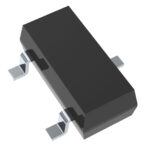 NE68133-T1B-R35-A
The activity of extra discounts on wholesale prices is in full swing…
Please fill in your contact information and we will send you the latest wholesale price list.





