 ChipApex | Global Electronic Components Supplier
SEARCH
Search Product
Search Post
— IC芯片 | 连接器 | 传感器 | 被动器件 —
Search productSearch post
— IC芯片 | 连接器 | 传感器 | 被动器件 —
Consult the customer manager about the wholesale price.
consultation hotline:86-132-6715-2157
email:[email protected]
Contact the product manager for consultation. One-stop consultation is available.
Do you want a lower wholesale price? Please send us your inquiry and we will reply immediately.
The PMEG3005CT,215 is a dual Schottky barrier rectifier in common cathode configuration. It features an average forward current of 0.5 A and a reverse voltage rating of 30 V. The device utilizes a SOT23 plastic package with low forward voltage characteristics. Key electrical parameters include a maximum forward voltage of 430 mV at 0.5 A and a maximum reverse current of 150 µA at 30 V. It supports a non-repetitive peak forward current of 10 A and operates within a junction temperature range up to 150 °C.
Verify the complete part number including the trailing suffix to ensure correct packaging and manufacturing site alignment. Confirm that the specific ordering code matches the required reel quantity or cut tape format. Cross-reference the marking code P9% followed by a manufacturing site placeholder against the latest Nexperia documentation to validate authenticity and traceability before finalizing procurement orders.
Select this component when a compact dual Schottky solution is required for low voltage circuits. The SOT23 package offers space efficiency compared to larger discrete packages. Ensure the application voltage does not exceed the 30 V reverse voltage limit. Consider the thermal resistance values provided in the datasheet for PCB layout planning to maintain junction temperatures within safe operating limits during continuous operation.
This device belongs to the PMEG series of low forward voltage Schottky barrier rectifiers manufactured by Nexperia. The series includes various configurations such as single diodes and dual common cathode types. These components are designed for high-speed switching and efficient power management in portable and automotive electronics, emphasizing low power loss and small footprint requirements.
PMEG3005ELS
Pin 1 is Anode 1, Pin 2 is Anode 2, and Pin 3 is the Common Cathode.
Yes, the PMEG3005CT is qualified in accordance with the AEC-Q101 standard for discrete semiconductors.
The maximum non-repetitive peak forward current is 10 A under specified test conditions.
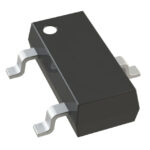 PMEG3005CT,215
The activity of extra discounts on wholesale prices is in full swing…
Please fill in your contact information and we will send you the latest wholesale price list.





