ChipApex | Global Electronic Components Supplier
SEARCH
Search Product
Search Post
— IC芯片 | 连接器 | 传感器 | 被动器件 —
Search productSearch post
— IC芯片 | 连接器 | 传感器 | 被动器件 —
Consult the customer manager about the wholesale price.
consultation hotline:86-132-6715-2157
email:[email protected]
Contact the product manager for consultation. One-stop consultation is available.
Do you want a lower wholesale price? Please send us your inquiry and we will reply immediately.
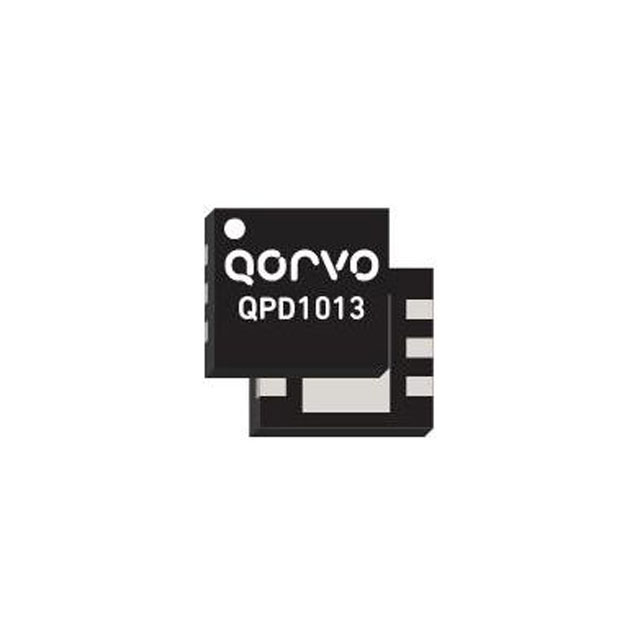
The QPD1013TR7 is a discrete Gallium Nitride on Silicon Carbide (GaN-on-SiC) High Electron Mobility Transistor (HEMT) designed for high-power radio frequency applications. It operates from DC to 2.7 GHz and delivers a saturated output power of 150 W at the P3dB compression point. The device utilizes a 65 V breakdown voltage technology, enabling robust performance in demanding RF environments. Packaged in a surface-mount format suitable for automated assembly, this single-stage unmatched transistor serves as a core active component for wideband power amplification.
Verify the specific suffix and tape-and-reel specifications against the manufacturer's latest datasheet before ordering. Confirm that the intended application environment supports the thermal requirements of GaN devices. Ensure that the supply chain source is authorized to guarantee component authenticity and traceability. Check for any recent product change notifications or lifecycle status updates regarding availability.
Select this component when designing wideband power amplifiers requiring high linearity and efficiency up to 2.7 GHz. Consider the need for external matching networks due to its unmatched topology. Evaluate thermal management solutions carefully, as the high power density necessitates effective heat dissipation. Compare against other GaN options if specific gain or bandwidth constraints differ from the standard DC-2.7 GHz range.
This part belongs to Qorvo's portfolio of discrete GaN RF transistors, which are engineered for high-performance wireless infrastructure. The QPD1013 series represents a class of rugged, high-power devices used in critical communication and defense systems. It complements Qorvo's broader ecosystem of RF components by providing the fundamental active element for high-efficiency power amplification stages.
Publicly confirmed substitute part numbers are not available in the provided documentation. Designers should consult official Qorvo resources for direct replacements or next-generation equivalents.
 QPD1013TR7
The activity of extra discounts on wholesale prices is in full swing…
Please fill in your contact information and we will send you the latest wholesale price list.