 ChipApex | Global Electronic Components Supplier
SEARCH
Search Product
Search Post
— IC芯片 | 连接器 | 传感器 | 被动器件 —
Search productSearch post
— IC芯片 | 连接器 | 传感器 | 被动器件 —
Consult the customer manager about the wholesale price.
consultation hotline:86-132-6715-2157
email:[email protected]
Contact the product manager for consultation. One-stop consultation is available.
Do you want a lower wholesale price? Please send us your inquiry and we will reply immediately.
The RB717FT106 is a Schottky barrier diode manufactured by Rohm Semiconductor, designed for use in computers, mobile phones, and various portable electronic devices. It features a low forward voltage (VF) and low reverse current (IR), alongside high electrostatic discharge (ESD) strength. The component is supplied in a UMD3 package, which corresponds to the SOT-323 JEITA package code, with dimensions of 2.1x2.0 mm (t=1.0). It operates with a maximum reverse voltage (VR) of 40V and an average rectified forward current (IO) of 0.03A. The device supports surface mount mounting styles and complies with RoHS standards.
Verify the specific ordering suffix and package variant when sourcing, as standard and automotive grades may differ. Confirm that the component is suitable for non-automotive applications, as standard-grade versions are not recommended for vehicle equipment. Ensure compliance with RoHS requirements if applicable to the target assembly. Cross-reference the exact part number with official distributor catalogs to confirm availability and authenticity before procurement.
Select this component for circuits requiring efficient rectification with minimal voltage drop in compact designs. The low capacitance and fast switching properties make it suitable for high-frequency applications in consumer electronics. Consider the thermal dissipation capabilities within the small UMD3 package when designing PCB layouts. Verify that the 40V reverse voltage rating exceeds the peak inverse voltage expected in the specific circuit application.
The RB717F series represents Rohm's standard-grade Schottky barrier diodes, known for their reliability and compact form factor. These diodes are part of Rohm's broader portfolio of semiconductor solutions for consumer electronics. The FT106 suffix typically indicates the tape and reel packaging format with a specific unit quantity. This series is distinct from automotive-grade variants, which may carry different suffixes or qualification standards.
Check for similar Schottky diodes with compatible voltage and current ratings. Ensure the replacement maintains the same package type for direct footprint compatibility. Verify that the alternative component meets the required forward voltage and reverse leakage specifications.
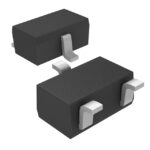 RB717FT106
The activity of extra discounts on wholesale prices is in full swing…
Please fill in your contact information and we will send you the latest wholesale price list.





