 ChipApex | Global Electronic Components Supplier
SEARCH
Search Product
Search Post
— IC芯片 | 连接器 | 传感器 | 被动器件 —
Search productSearch post
— IC芯片 | 连接器 | 传感器 | 被动器件 —
Consult the customer manager about the wholesale price.
consultation hotline:86-132-6715-2157
email:[email protected]
Contact the product manager for consultation. One-stop consultation is available.
Do you want a lower wholesale price? Please send us your inquiry and we will reply immediately.
The Vishay Siliconix SI4914BDY-T1-GE3 is a dual N-channel 30-V MOSFET with an integrated Schottky diode in an SO-8 package. Channel-1 offers a maximum RDS(on) of 21 mΩ at VGS = 10 V and 27 mΩ at VGS = 4.5 V, with a continuous drain current (ID) of 8.4 A. Channel-2 provides a maximum RDS(on) of 20 mΩ at VGS = 10 V and 25 mΩ at VGS = 4.5 V, supporting an ID of 8 A. The device features a typical total gate charge (Qg) of 6.7 nC for Channel-1 and 7.0 nC for Channel-2. It includes a Schottky diode with a forward voltage of 0.50 V at IF = 1.0 A.
Verify the specific ordering suffix when sourcing components. The -E3 suffix indicates lead-free construction, while the -GE3 suffix confirms both lead-free and halogen-free compliance according to IEC 61249-2-21 standards. Confirm that the received parts match the exact alphanumeric designation required for the design to ensure regulatory adherence.
Select this component for applications requiring compact dual-switching solutions with synchronous rectification capabilities. The shared source/drain configuration simplifies PCB layout for half-bridge or full-bridge topologies. Evaluate thermal management requirements based on the junction-to-ambient resistance values provided in the datasheet for steady-state and pulsed operations.
This part belongs to the Vishay Siliconix Si4914BDY series, which utilizes the LITTLE FOOT Plus packaging format. The series is designed for high-density power management applications where space constraints are critical. The integration of the Schottky diode alongside the dual MOSFETs distinguishes it from standard dual-transistor packages.
SI4914BDY-T1-E3
Pin 5 serves as the common Source for Channel-1 and Drain for Channel-2 (S1/D2), facilitating efficient layout for bridge configurations.
Yes, the Schottky diode is connected between the Source and Drain of Channel-2, providing a separate path for reverse recovery currents.
The Gate Threshold Voltage (VGS(th)) exhibits a negative temperature coefficient, decreasing by approximately 6.2 mV/°C as the junction temperature increases.
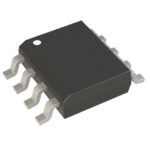 SI4914BDY-T1-GE3
The activity of extra discounts on wholesale prices is in full swing…
Please fill in your contact information and we will send you the latest wholesale price list.





