ChipApex | Global Electronic Components Supplier
SEARCH
Search Product
Search Post
— IC芯片 | 连接器 | 传感器 | 被动器件 —
Search productSearch post
— IC芯片 | 连接器 | 传感器 | 被动器件 —
Consult the customer manager about the wholesale price.
consultation hotline:86-132-6715-2157
email:[email protected]
Contact the product manager for consultation. One-stop consultation is available.
Do you want a lower wholesale price? Please send us your inquiry and we will reply immediately.
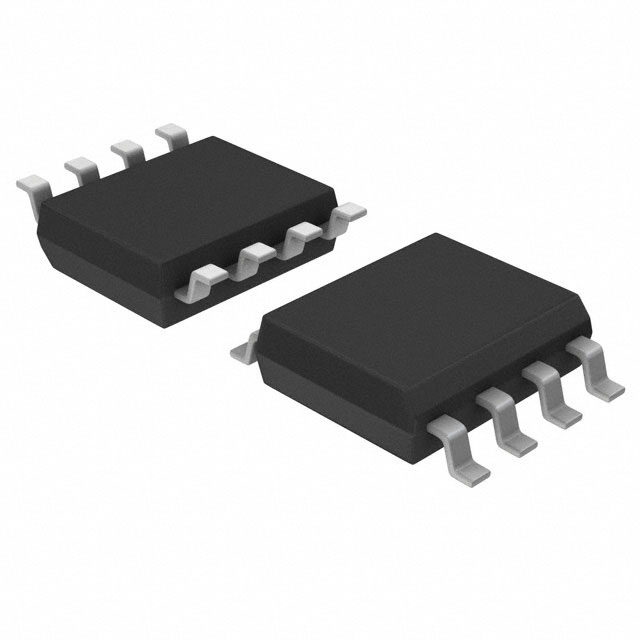
The Vishay Siliconix SI4946CDY-T1-GE3 is a dual N-channel enhancement mode MOSFET utilizing TrenchFET technology. It features a 60 V drain-source voltage rating and a maximum continuous drain current of 6.1 A at a case temperature of 25 °C. The device offers a typical on-state resistance of 0.033 Ω at VGS = 10 V and 0.043 Ω at VGS = 4.5 V. Total gate charge is typically 5.1 nC at VGS = 10 V, with a threshold voltage ranging from 1 V to 3 V. It operates within a junction temperature range of -55 °C to +150 °C and is housed in an SO-8 surface-mount package.
Verify the specific ordering suffix '-T1-GE3' to confirm lead-free and halogen-free compliance as defined by Vishay standards. Ensure that the SO-8 package dimensions align with the recommended minimum pad layout provided in Application Note 826 to guarantee reliable surface mounting during assembly processes.
Select this component when a dual N-channel topology is required for 60 V applications. The low gate charge characteristics support efficient switching in high-frequency environments. Evaluate the thermal derating curves against the expected ambient temperatures to ensure the continuous drain current remains within safe operating limits under steady-state conditions.
This part belongs to the Vishay Siliconix Si4946 series of dual N-channel MOSFETs. It shares the same pinout and general electrical specifications as the SI4946BEY-T1-E3 and SQ4946CEY-T1_GE3 variants, differing primarily in manufacturing lot codes or minor parameter tolerances rather than fundamental functional changes.
SI4946BEY-T1-E3
The device supports a single pulse avalanche current (IAS) of 8 A with an energy rating of 3.2 mJ, and a general pulsed drain current (IDM) of 25 A for a duration of 100 μs.
At VGS = 10 V, the maximum RDS(on) is 0.0409 Ω. When driven at VGS = 4.5 V, the maximum RDS(on) increases to 0.0516 Ω.
The body diode exhibits a typical reverse recovery time (trr) of 21 ns and a reverse recovery charge (Qrr) of 1235 nC when tested at IF = 4.2 A and di/dt = 100 A/μs.
 SI4946CDY-T1-GE3
The activity of extra discounts on wholesale prices is in full swing…
Please fill in your contact information and we will send you the latest wholesale price list.