ChipApex | Global Electronic Components Supplier
SEARCH
Search Product
Search Post
— IC芯片 | 连接器 | 传感器 | 被动器件 —
Search productSearch post
— IC芯片 | 连接器 | 传感器 | 被动器件 —
Consult the customer manager about the wholesale price.
consultation hotline:86-132-6715-2157
email:[email protected]
Contact the product manager for consultation. One-stop consultation is available.
Do you want a lower wholesale price? Please send us your inquiry and we will reply immediately.
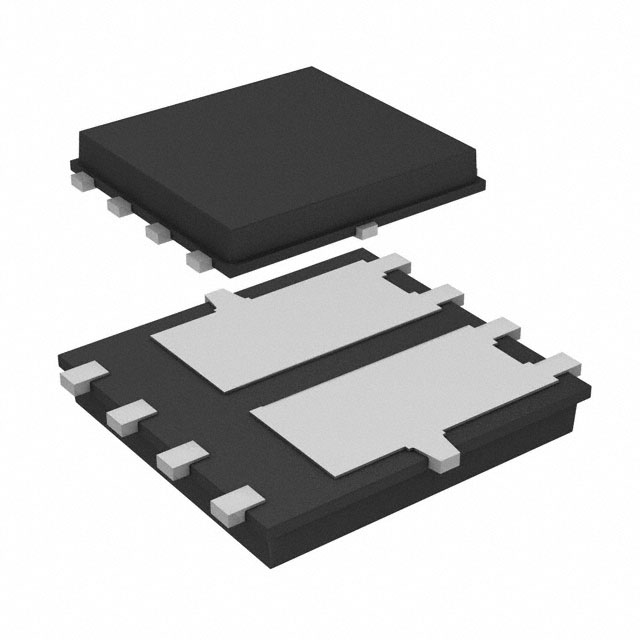
The Vishay Siliconix SISF02DN-T1-GE3 is a common-drain dual N-channel MOSFET utilizing TrenchFET Gen IV technology. It features an integrated low source-to-source on-resistance optimized for bi-directional current flow in a compact PowerPAK 1212-8SCD package. The device supports a drain-source voltage of 25 V and a continuous source current of 60 A at TC = 25 °C. Maximum on-resistance is 3.5 mΩ at VGS = 10 V and 5.6 mΩ at VGS = 4.5 V. Gate charge is typically 16.9 nC at VGS = 4.5 V. Thermal resistance from junction to case is 1.4 °C/W typical, with a maximum operating junction temperature of 150 °C.
Verify the specific ordering suffix -T1-GE3 against official Vishay documentation to confirm reel packaging and halogen-free compliance. Ensure the component matches the PowerPAK 1212-8SCD footprint requirements. Cross-reference datasheet revision S19-0104-Rev. A for accurate thermal and electrical parameters before finalizing procurement specifications.
Select this component when a low-profile solution for bi-directional switching is required. The common-drain topology simplifies circuit layout compared to discrete back-to-back configurations. Verify that the gate drive voltage meets the threshold requirements for the desired on-resistance level. Confirm thermal management capabilities align with the specified junction-to-case resistance ratings.
This part belongs to the SISF series of dual N-channel MOSFETs designed specifically for applications requiring bidirectional current control. It utilizes flip-chip technology within the PowerPAK 1212-8SCD package to minimize parasitic inductance and improve thermal performance. The device represents an evolution in low-voltage power switching solutions offered by Vishay Siliconix.
No public confirmed substitute part numbers are available in the provided documentation.
The maximum source-to-source on-resistance (RS1S2(on)) is 3.5 mΩ at VGS = 10 V and 5.6 mΩ at VGS = 4.5 V.
Yes, the device exhibits low gate charge (typical 16.9 nC at VGS = 4.5 V) and fast switching times, making it suitable for high-frequency applications.
The datasheet references a specific solder profile document (www.vishay.com/doc?73257). Manual soldering with an iron is not recommended for this leadless component.
 SISF02DN-T1-GE3
The activity of extra discounts on wholesale prices is in full swing…
Please fill in your contact information and we will send you the latest wholesale price list.