 ChipApex | Global Electronic Components Supplier
SEARCH
Search Product
Search Post
— IC芯片 | 连接器 | 传感器 | 被动器件 —
Search productSearch post
— IC芯片 | 连接器 | 传感器 | 被动器件 —
Consult the customer manager about the wholesale price.
consultation hotline:86-132-6715-2157
email:[email protected]
Contact the product manager for consultation. One-stop consultation is available.
Do you want a lower wholesale price? Please send us your inquiry and we will reply immediately.
The SP8M70TB1 is a complementary MOSFET manufactured by ROHM Semiconductor, designed for low-voltage driving applications. It features an N-channel and P-channel pair integrated in a single SOP8 surface-mount package. The device supports a drive voltage of 4V, enabling efficient switching with reduced gate charge requirements. Key electrical parameters include a Drain-Source Voltage (V_DSS) of 30V and a continuous Drain Current (I_D) of 7.0A for the N-channel variant. The typical on-resistance (R_DS(on)) at 4V gate drive is specified as 0.025Ω, ensuring low conduction losses. Total gate charge (Q_g) is typically 12nC. The component operates within a storage temperature range of -55°C to 150°C and complies with RoHS standards.
Verify the specific ordering suffix TB1 to confirm tape-and-reel packaging quantities of 2500 units per reel. Ensure compatibility with SOP8 footprint dimensions of 6.0x5.0mm during PCB layout. Confirm RoHS compliance status if environmental regulations apply to the final assembly. Check supply status as this series may be subject to production lifecycle changes.
Select this component when a matched N/P pair is required for half-bridge or high-side/low-side configurations. The 4V drive capability makes it suitable for microcontrollers or drivers operating at lower logic levels than standard 10V MOSFETs. Consider the 30V V_DSS rating for systems with nominal voltages up to 24V. Evaluate thermal performance based on the 2W power dissipation limit in the SOP8 package.
The SP8M70TB1 belongs to ROHM's lineup of 4V-driven complementary MOSFETs. It serves as a solution for applications needing synchronized switching actions from a single package. The SOP8 form factor provides a balance between current handling capacity and board space efficiency compared to discrete solutions.
The SP8M4HZG is listed as a similar level replacement with the same pinout and package. Verify that the SP8M4HZG's higher drain current rating of 9.0A and different R_DS(on) values meet the circuit requirements before substitution.
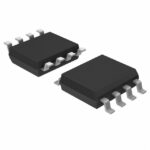 SP8M70TB1
The activity of extra discounts on wholesale prices is in full swing…
Please fill in your contact information and we will send you the latest wholesale price list.





