 ChipApex | Global Electronic Components Supplier
SEARCH
Search Product
Search Post
— IC芯片 | 连接器 | 传感器 | 被动器件 —
Search productSearch post
— IC芯片 | 连接器 | 传感器 | 被动器件 —
Consult the customer manager about the wholesale price.
consultation hotline:86-132-6715-2157
email:[email protected]
Contact the product manager for consultation. One-stop consultation is available.
Do you want a lower wholesale price? Please send us your inquiry and we will reply immediately.
The UPA814T is a dual NPN silicon high-frequency transistor manufactured by CEL. It integrates two NE688 dies within an ultra-small S06 package measuring 2 mm x 1.25 mm. The device features a gain bandwidth product (fT) of 9 GHz and a typical noise figure of 1.5 dB at 2 GHz. Maximum collector current is rated at 100 mA, with total power dissipation reaching 200 mW for the dual-die configuration. Collector-to-emitter voltage is limited to 6 V, while collector-to-base voltage is 9 V. The component supports low-voltage biasing and is designed for compact wireless applications.
Verify the specific ordering suffix when sourcing this component. The base part number UPA814T denotes the standard version, while the -A suffix indicates RoHS compliance and lead-free terminals. Tape and reel packaging is available under the UPA814T-T1-A designation. Confirm environmental compliance requirements against the manufacturer's certification documentation prior to procurement.
Select this component for designs requiring dual matched transistors in minimal board space. Ensure the operating frequency aligns with the 9 GHz gain bandwidth specification. Verify that the 6 V collector-to-emitter voltage rating accommodates the circuit's maximum supply conditions. Consider the thermal constraints associated with the small package size during layout planning.
This component belongs to the family of high-frequency silicon epitaxial transistors originally developed by NEC and distributed by California Eastern Laboratories. The UPA814T utilizes the NE688 die architecture to provide high performance in a reduced footprint compared to discrete alternatives. It serves as a specialized solution for mobile telecommunications hardware where size and electrical efficiency are critical design parameters.
Direct substitutes include the UPA813T series variants such as UPA813T-T1-FB. These components share similar RF characteristics and package outlines but may differ in specific gain or noise parameters. Verify pin compatibility and electrical ratings before implementing any cross-model replacement.
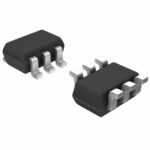 UPA814T-T1
The activity of extra discounts on wholesale prices is in full swing…
Please fill in your contact information and we will send you the latest wholesale price list.






