 ChipApex | Global Electronic Components Supplier
SEARCH
Search Product
Search Post
— IC芯片 | 连接器 | 传感器 | 被动器件 —
Search productSearch post
— IC芯片 | 连接器 | 传感器 | 被动器件 —
Consult the customer manager about the wholesale price.
consultation hotline:86-132-6715-2157
email:[email protected]
Contact the product manager for consultation. One-stop consultation is available.
Do you want a lower wholesale price? Please send us your inquiry and we will reply immediately.
The ZMV829BTC is a silicon hyperabrupt varactor diode from the 830 series, designed for frequency control and filtering applications. It features closely controlled capacitance-voltage characteristics and high Q factors. The nominal capacitance is 8.2 pF with a tolerance of ±10%, ranging from 7.79 pF to 8.61 pF at 2V reverse bias. It offers a minimum capacitance ratio (C2/C20) of 4.3 and a typical reverse leakage current of 20 nA at 20V. The device operates within a temperature range of -55°C to +150°C and is housed in an SOT-23 surface mount package.
Verify the specific ordering suffix 'BTC' against manufacturer documentation to confirm tape and reel specifications. The datasheet indicates that 'TA' denotes 7-inch reels while 'TC' denotes 13-inch reels; ensure the requested packaging matches production requirements. Confirm RoHS compliance status as per the latest product announcements. Source components through authorized distributors to guarantee authenticity and traceability.
Select this component when a nominal capacitance near 8.2 pF is required for VCO tuning ranges. The hyperabrupt characteristic makes it suitable for wideband frequency sweeping applications compared to abrupt or linear graded variants. Ensure the circuit design accommodates the specified maximum reverse voltage and power dissipation limits for the SOT-23 package under expected thermal conditions.
This part belongs to the Zetex 830 series of silicon hyperabrupt varactor diodes, which also includes single and dual common cathode configurations like the ZC829 and ZMDC830. Originally manufactured by Zetex Semiconductors plc, the brand was acquired by Diodes Incorporated. The series is engineered for low phase noise and stable capacitance-voltage curves in RF front-end designs.
Direct substitutes within the same series include ZMV829ATA and ZMV829BTA, which share identical electrical characteristics but may differ in packaging quantities or marking codes. Verify pinout compatibility and package dimensions before substitution.
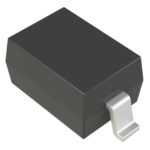 ZMV829BTC
The activity of extra discounts on wholesale prices is in full swing…
Please fill in your contact information and we will send you the latest wholesale price list.





