 ChipApex | Global Electronic Components Supplier

SEARCH
Search Product
Search Post
— IC芯片 | 连接器 | 传感器 | 被动器件 —
Search productSearch post
— IC芯片 | 连接器 | 传感器 | 被动器件 —
The trend of science and technology is changing rapidly.
A gas sensor responds to a gas through a physical or chemical sensing mechanism and produces a signal that electronics can interpret. Choosing one starts with the target gas, concentration range and intended use. A sensor suited to ventilation control may be unsuitable for leak detection or a life-safety alarm.
The available gas sensor types use different principles. No single technology measures every gas with equal sensitivity, selectivity and stability. A useful specification includes interfering gases and environmental conditions, not just the gas you want to detect.
A complete system includes the sensing element, signal conditioning, power, mechanical gas access, processing and an output or alarm function. The sensing element alone is not a finished detector. Its enclosure, airflow and calibration can substantially change the system response.
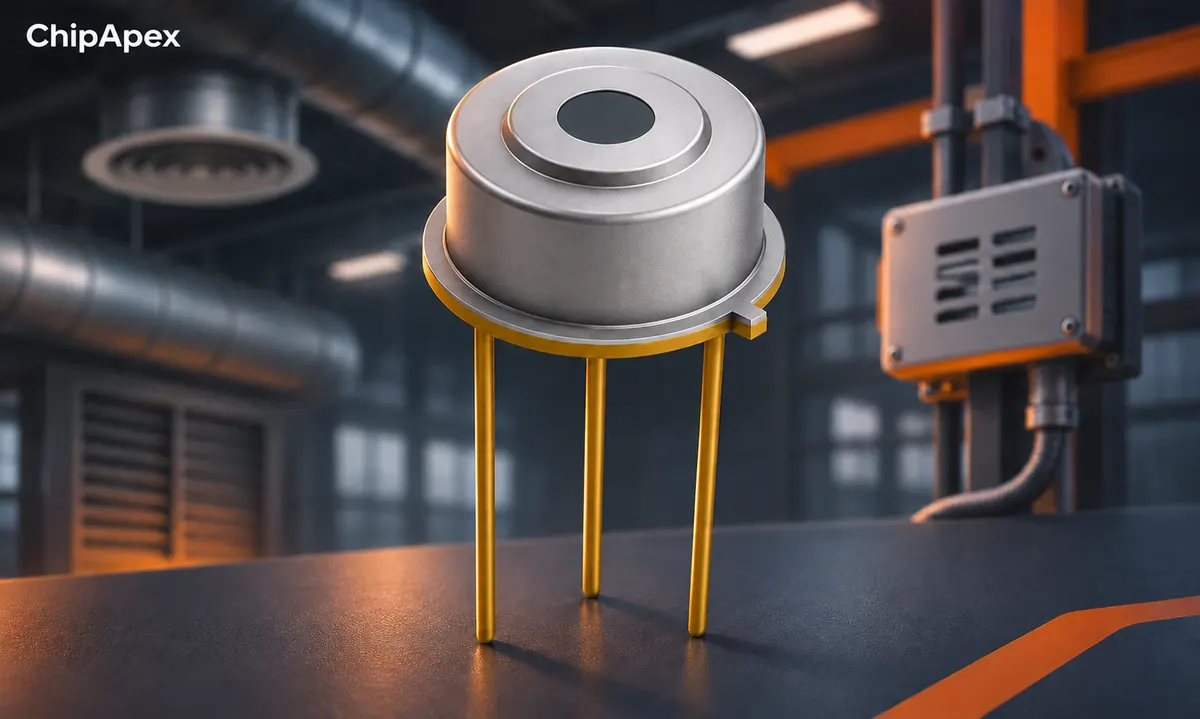
A raw sensor may provide a small current, resistance change or optical signal. A module may add conditioning and a digital interface. Even a digital output needs interpretation: check whether it reports calibrated concentration, a relative index or an estimated equivalent value.
For example, an estimated equivalent CO2 value derived from a broad air-quality response is not the same measurement as directly sensing CO2. The distinction matters when specifying ventilation controls or comparing readings from different instruments.
| Technology | Basic response | Selection consideration |
|---|---|---|
| Electrochemical | Gas reaction produces an electrical signal | Target gas, cross-sensitivity, life and environmental limits |
| Metal oxide semiconductor | Surface interaction changes resistance | Heater power, humidity, baseline drift and broad response |
| NDIR | Gas absorbs selected infrared wavelengths | Gas absorption spectrum, optical path and compensation |
| Catalytic bead | Combustible gas reaction changes element temperature | Oxygen requirements, poisoning and application suitability |
| Photoionization | Ultraviolet light ionizes responsive compounds | Lamp energy, response factors and maintenance |
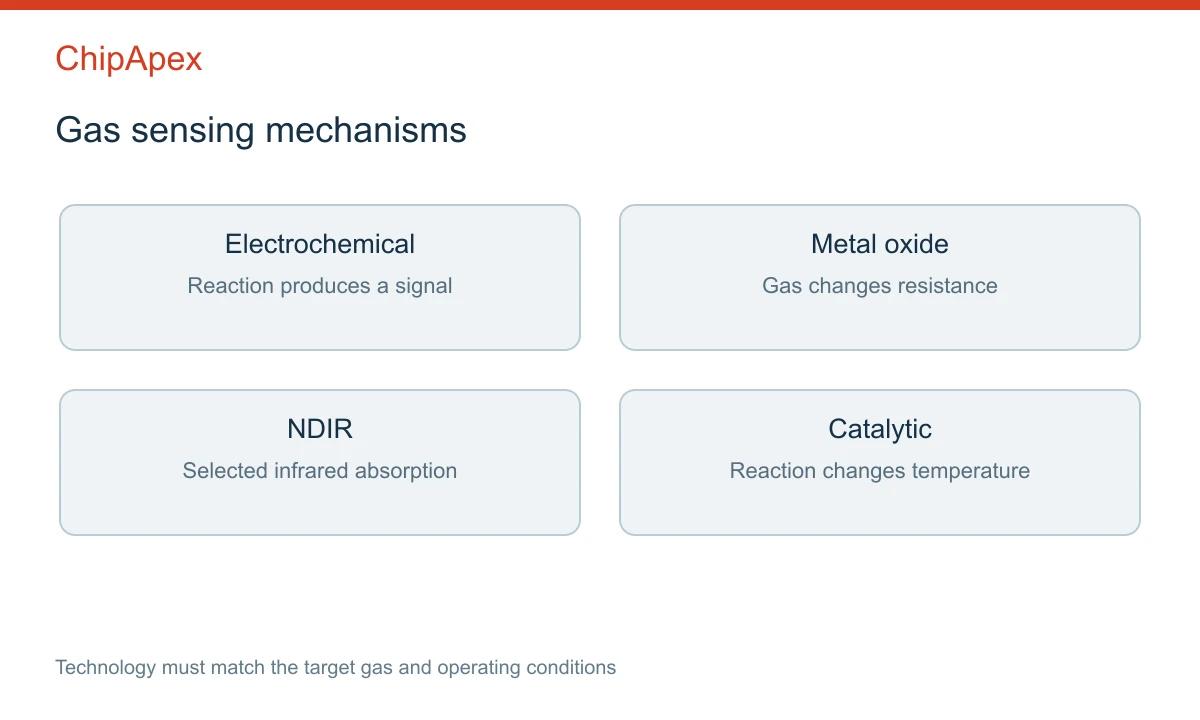
These are broad categories, not interchangeable choices. An NDIR design must target a gas with suitable infrared absorption. A catalytic sensor's operating conditions must support its reaction. Electrochemical sensors can have meaningful responses to gases other than the intended target.
MEMS describes a fabrication approach rather than a separate universal sensing principle. A MEMS device may still use a heated metal oxide element or another mechanism. Select by the actual measurement principle and datasheet, not by the MEMS label alone.
Manufacturer gas sensor product information illustrates the range of technologies and intended applications. Part-level documentation is needed to determine the appropriate gas and operating range.
Concentration may be expressed in ppm, volume percent or percent of the lower explosive limit. These units describe different quantities or reference scales. Do not compare their numbers without understanding the gas and the conversion basis.
Specify minimum useful detection level, full-scale range, accuracy and response time under stated conditions. A fast sensing element behind a restrictive enclosure may produce a slow detector. Tubing, filters, diffusion barriers and sampling pumps can add delay or alter the sample.
Cross-sensitivity is often decisive. A sensor that responds to the target gas may also respond to cleaning solvents, exhaust components or background vapors. Ask which substances are expected in the application and whether their response is positive, negative or damaging. A response curve for one gas does not prove selectivity in a mixture.
Temperature, humidity, pressure and oxygen concentration may also affect readings. Compensation helps only within the characterized operating conditions. Condensation, contamination and poisoning require separate consideration.
Calibration establishes or adjusts the relationship between sensor output and a known gas concentration under a defined procedure. A bump test checks that the instrument responds and its alarm functions operate; it is not a substitute for quantitative calibration.
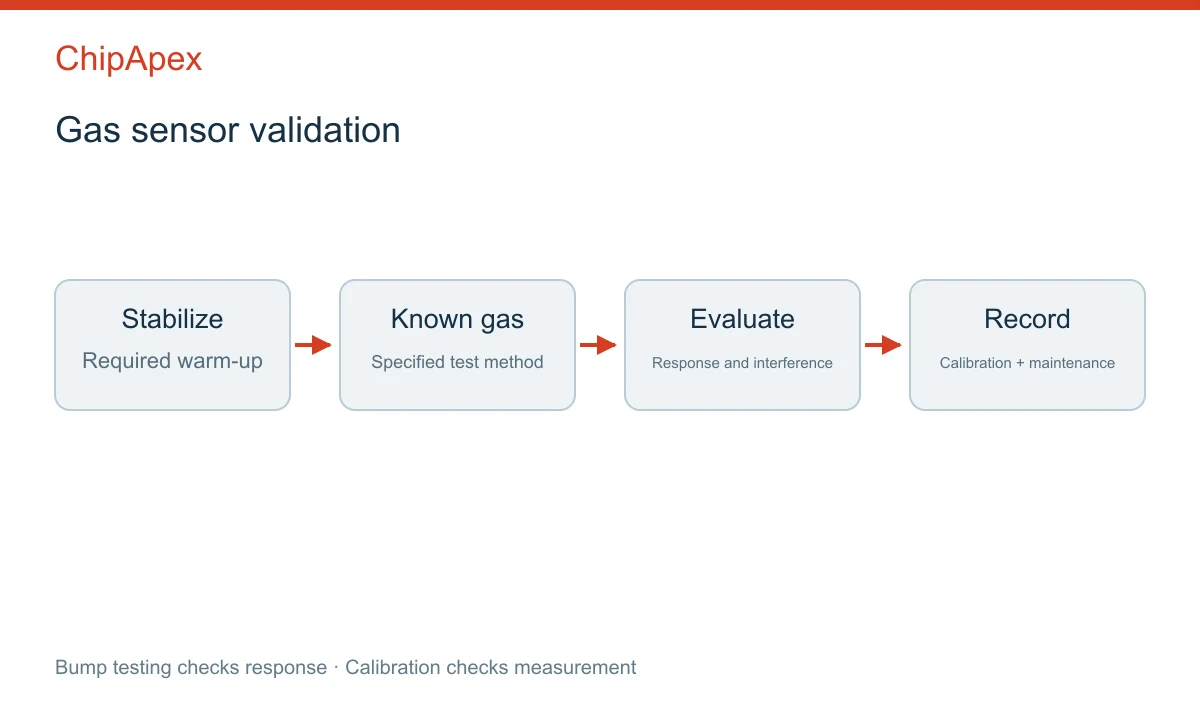
Use the manufacturer's specified gas, concentration, delivery method and timing. Some sensors need conditioning or warm-up after storage or power-up. The required interval is device-specific, so a universal “wait a few seconds” rule is unreliable.
Sensors can change with age and exposure. Heater behavior, electrolyte condition, optical contamination and catalyst poisoning depend on the technology. Maintenance plans should follow the detector and sensor documentation, the application requirements and actual service conditions. Do not invent an alarm threshold or replacement interval from a generic article.
The manufacturer's gas sensor FAQ is useful when reviewing handling and operating limitations. Check the selected model's documentation because behavior differs across sensor families.
An electrochemical sensor may require a low-bias-current interface and controlled electrode potentials. A resistive sensor may need heater control and a resistance measurement circuit. Optical sensing adds source control and detector processing. These requirements determine the appropriate analog front end.
Where the signal is digitized externally, match the adc converter to the sensor output, required noise performance and sampling rate. Excessive digital filtering may reduce noise while delaying response, so assess both effects in the completed instrument.
Locate gas openings with attention to actual airflow, gas behavior and enclosure requirements. Avoid placing the sensing element where heat, contamination or assembly chemicals can invalidate its operating conditions. Follow the manufacturer's soldering and handling instructions.
Send ChipApex the target gas, range and units, sensing principle if known, raw-sensor or module requirement, interface, supply, environment and quantity. Include the preferred manufacturer part number and any mandatory system or component requirements.
Browse gas sensors once those conditions are defined. Ask for the exact datasheet and availability confirmation rather than selecting from package appearance. For a safety-related detector, component selection must remain part of the complete system's applicable validation and certification process.
No. Some sensors respond broadly, but response is not the same as reliable identification or accurate concentration measurement. Selectivity and cross-sensitivity must be evaluated.
Some are, while others provide raw or partially processed output. Check the calibration conditions, specified lifetime and whether application-level calibration is still required.
Humidity can affect the sensing mechanism, surface behavior or gas transport. The magnitude and direction depend on the technology and model.
No. It simplifies communication but does not remove sensor drift, interference or calibration requirements.
Only if the complete detector is designed and validated for that alarm application. An air-quality index or broad VOC response does not establish a reliable safety alarm function.
Discover why SRAM remains essential in industrial, medical & aerospace systems—thanks to its deterministic performance and long-term reliability. Trusted by engineers worldwide.
View details
Discover what DRAM is, how it works, its types, and why choosing authentic, RoHS-compliant DRAM chips matters. Source reliable DRAM from ChipApex—global supplier with full traceability.
View details
Practical MCU selection guide for engineers: compare STM32, ESP32 & NXP, avoid counterfeits, and ensure supply chain reliability. Authored by ChipApex FAE.
View details
Discover how NOR flash enables fast code execution in embedded systems, its key types (Parallel/SPI), and how to source authentic, traceable ICs from trusted suppliers.
View details
The activity of extra discounts on wholesale prices is in full swing…
Please fill in your contact information and we will send you the latest wholesale price list.

