 ChipApex | Global Electronic Components Supplier
SEARCH
Search Product
Search Post
— IC芯片 | 连接器 | 传感器 | 被动器件 —
Search productSearch post
— IC芯片 | 连接器 | 传感器 | 被动器件 —
Consult the customer manager about the wholesale price.
consultation hotline:86-132-6715-2157
email:[email protected]
Contact the product manager for consultation. One-stop consultation is available.
Do you want a lower wholesale price? Please send us your inquiry and we will reply immediately.
The ATF-58143-BLKG is a low noise enhancement mode pseudomorphic HEMT (EpHEMT) manufactured by Broadcom Limited using Gallium Arsenide (GaAs) technology. Designed for surface mount applications in the SOT-343 package, this single N-channel transistor operates at frequencies up to 2 GHz. Key electrical parameters include a typical noise figure of 0.5 dB, an associated gain of 16.5 dB, and an output third-order intercept point of 30.5 dBm. It functions optimally at a drain-source voltage of 3 V with a continuous drain current of 30 mA, delivering 19 dBm output power at 1 dB compression. The device supports a maximum operating temperature of +150 C.
Verify component authenticity through authorized distributors or direct manufacturer channels due to potential availability constraints. Confirm RoHS compliance status and specific lot traceability requirements before procurement. Ensure storage conditions adhere to moisture sensitivity levels defined in the datasheet to maintain device integrity prior to assembly.
Select this component for designs requiring minimal signal degradation in RF front-end stages. The SOT-343 package suits space-constrained PCB layouts. Evaluate thermal management capabilities as the device dissipates power during operation. Ensure biasing circuits support the specified 3 V drain voltage and 30 mA current limits for optimal linearity and noise performance.
This part belongs to the ATF-58143 family of EpHEMT transistors originally developed by Agilent Technologies and later maintained by Broadcom. The BLKG suffix typically denotes specific packaging or lead-free configuration variants within the standard ATF-58143 specification. These devices are engineered for high-frequency analog applications where signal fidelity is critical.
Direct substitutes may include other GaAs EpHEMTs from Broadcom or Agilent with compatible SOT-343 footprints. Verify that alternative components match the 0.5 dB noise figure and 16.5 dB gain specifications. Check pinout compatibility and thermal resistance values to ensure seamless integration without redesigning the surrounding RF circuitry.
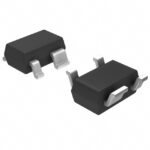 ATF-58143-BLKG
The activity of extra discounts on wholesale prices is in full swing…
Please fill in your contact information and we will send you the latest wholesale price list.





