 ChipApex | Global Electronic Components Supplier

SEARCH
Search Product
Search Post
— IC芯片 | 连接器 | 传感器 | 被动器件 —
Search productSearch post
— IC芯片 | 连接器 | 传感器 | 被动器件 —
Consult the customer manager about the wholesale price.
consultation hotline:86-132-6715-2157
email:[email protected]
Contact the product manager for consultation. One-stop consultation is available.
Do you want a lower wholesale price? Please send us your inquiry and we will reply immediately.
The BC817-25WHE3-TP is an NPN silicon bipolar junction transistor manufactured by Micro Commercial Components. It features a single configuration in an SOT-323-3 surface-mount package. Key electrical ratings include a maximum collector-emitter voltage of 45 V, a collector-base voltage of 50 V, and an emitter-base voltage of 5 V. The device supports a continuous DC collector current of 500 mA with a power dissipation of 200 mW. It exhibits a gain-bandwidth product of 100 MHz and operates within a temperature range of -55°C to +150°C. The component holds AEC-Q101 qualification for automotive applications.
Verify the specific suffix WHE3-TP against official Micro Commercial Components documentation to confirm the exact pinout and electrical tolerances for the SOT-323-3 variant. Ensure that procurement channels provide valid traceability records and authenticity guarantees. Confirm that the delivered units match the AEC-Q101 qualification status specified in the manufacturer's datasheet before integration into production lines.
Select this component when an NPN transistor with 45V collector-emitter voltage and 500mA current capacity is required in a compact SOT-323-3 footprint. Consider this part for designs needing AEC-Q101 compliance and operation up to 150°C junction temperature. Evaluate the 200mW power dissipation limit and 100MHz transition frequency against the specific signal and thermal requirements of the target application circuit.
This device belongs to the BC817 series of NPN general-purpose transistors produced by Micro Commercial Components. The series offers various voltage and packaging options to suit different design constraints. The BC817-25WHE3-TP specifically utilizes the SOT-323-3 package, distinguishing it from other series members that may use SOT-23 or larger packages while maintaining similar core electrical characteristics.
Cross-reference with other manufacturers offering NPN transistors in SOT-323-3 packages with matching 45V VCEO and 500mA Ic ratings. Verify that potential substitutes meet the same AEC-Q101 automotive qualification standards and operate within the specified -55°C to +150°C temperature range to ensure functional compatibility.
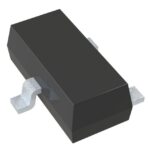 BC817-25WHE3-TP

The activity of extra discounts on wholesale prices is in full swing…
Please fill in your contact information and we will send you the latest wholesale price list.





