 ChipApex | Global Electronic Components Supplier
SEARCH
Search Product
Search Post
— IC芯片 | 连接器 | 传感器 | 被动器件 —
Search productSearch post
— IC芯片 | 连接器 | 传感器 | 被动器件 —
Consult the customer manager about the wholesale price.
consultation hotline:86-132-6715-2157
email:[email protected]
Contact the product manager for consultation. One-stop consultation is available.
Do you want a lower wholesale price? Please send us your inquiry and we will reply immediately.
The BC857BLT3G is a PNP silicon general-purpose transistor from the onsemi BC856ALT1G series, housed in an SOT-23 (TO-236) surface-mount package. It features a collector-emitter voltage of -45 V and a continuous collector current of -100 mA. The device offers a DC current gain range of 220 to 475 at -2.0 mA and -5.0 V. Key electrical characteristics include a transition frequency of 100 MHz and a maximum power dissipation of 225 mW on an FR-5 board. Operating temperatures range from -55°C to +150°C.
Verify the specific ordering prefix (S or NSV) if automotive qualification and PPAP capability are required, as these attributes apply only to designated prefixes within the BC856ALT1G series. Confirm the package style pinout configuration matches the design schematic, as SOT-23 packages may vary by manufacturer style definitions. Ensure compliance with RoHS and halogen-free specifications during component sourcing.
Select this component for designs requiring a PNP transistor with a -45 V collector-emitter breakdown voltage and moderate current handling capabilities. The BC857B grade provides a guaranteed minimum DC current gain of 220, making it suitable for applications needing consistent amplification factors. Consider the thermal resistance and power dissipation limits when designing heat management strategies for dense PCB layouts.
This part belongs to the BC856ALT1G series, which includes complementary NPN types like the BC847B. The series is engineered for low-power surface mount applications, offering a compact footprint ideal for modern electronic devices. The BC857 variant specifically addresses PNP circuit needs with standardized electrical characteristics compatible with industry-standard switching and amplification topologies.
Direct substitutes include other BC857B variants from different manufacturers such as Diodes Incorporated or Nexperia, provided they match the SOT-23 package and electrical ratings. Verify pinout compatibility and hFE binning before substitution to ensure circuit performance remains within specified tolerances.
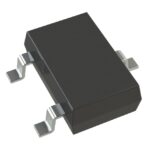 BC857BLT3G
The activity of extra discounts on wholesale prices is in full swing…
Please fill in your contact information and we will send you the latest wholesale price list.





