 ChipApex | Global Electronic Components Supplier
SEARCH
Search Product
Search Post
— IC芯片 | 连接器 | 传感器 | 被动器件 —
Search productSearch post
— IC芯片 | 连接器 | 传感器 | 被动器件 —
Consult the customer manager about the wholesale price.
consultation hotline:86-132-6715-2157
email:[email protected]
Contact the product manager for consultation. One-stop consultation is available.
Do you want a lower wholesale price? Please send us your inquiry and we will reply immediately.
The BC857C-QVL is a PNP general-purpose bipolar junction transistor manufactured by Nexperia. It operates with a maximum collector-emitter voltage of 45 V and supports a continuous collector current of 100 mA. The device features a DC current gain (hFE) ranging from 100 to 200 at a collector current of -2 mA. It is housed in an ultra-small DFN1412D-3 (SOT8009) leadless surface-mount package, designed for efficient board space utilization. The component is qualified to the AEC-Q101 standard for automotive applications and offers a power dissipation capability suitable for low-power signal processing tasks.
Verify the specific suffix QVL against official Nexperia documentation to confirm the exact tape-and-reel packaging configuration and binning specifications. Ensure that the AEC-Q101 qualification status aligns with your project's automotive grade requirements. Cross-reference the SOT8009 footprint dimensions during PCB layout finalization to guarantee mechanical compatibility.
Select this component when a compact PNP transistor with automotive-grade reliability is required. The DFN1412D-3 package is ideal for space-constrained designs where traditional leads are impractical. Consider the hFE range of 100 to 200 for biasing stability in amplifier stages. Verify thermal management needs against the package's power dissipation limits for high-density assemblies.
This part belongs to the BC857 series of general-purpose PNP transistors from Nexperia. It serves as the complement to the BC847 NPN series. The QVL suffix indicates a specific packaging variant within the broader BC857 family, which includes various packages like SOT23 and DFN options. The series is widely used in consumer electronics and automotive systems for signal conditioning.
Direct substitutes include other AEC-Q101 qualified PNP transistors in the SOT8009 package, such as the BC857CQC. Verify pinout compatibility and electrical parameters before substitution. Alternative packages like SOT23 may require schematic redesign due to pin differences.
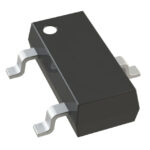 BC857C-QVL
The activity of extra discounts on wholesale prices is in full swing…
Please fill in your contact information and we will send you the latest wholesale price list.





