 ChipApex | Global Electronic Components Supplier
SEARCH
Search Product
Search Post
— IC芯片 | 连接器 | 传感器 | 被动器件 —
Search productSearch post
— IC芯片 | 连接器 | 传感器 | 被动器件 —
Consult the customer manager about the wholesale price.
consultation hotline:86-132-6715-2157
email:[email protected]
Contact the product manager for consultation. One-stop consultation is available.
Do you want a lower wholesale price? Please send us your inquiry and we will reply immediately.
The BFR540 is an NPN silicon planar epitaxial transistor housed in a SOT23 plastic package. It operates with a collector-base voltage of 20 V and supports a DC collector current up to 120 mA, dissipating 500 mW at temperatures below 70 °C. The device features a transition frequency of 9 GHz and a maximum unilateral power gain of 14 dB at 900 MHz. Noise figures range from 1.3 dB to 2.4 dB depending on bias conditions. Gold metallization ensures high reliability for wideband RF applications.
Verify the component against the official NXP datasheet Rev. 6 specifications before integration. Confirm that the physical marking code matches the '33' identifier followed by a country-specific suffix indicating manufacturing origin. Ensure the supplier provides traceability documentation consistent with the SOT23 package outline and lead configuration defined in the product data sheet.
Select this transistor for designs requiring high-frequency performance up to 9 GHz with low noise characteristics. Evaluate the thermal resistance from junction to soldering point, which is 260 K/W, to ensure adequate heat dissipation within the 500 mW total power dissipation limit. Verify that the operating collector current remains within the 120 mA DC rating to maintain stability and prevent exceeding absolute maximum ratings during peak signal conditions.
This component belongs to the category of NPN silicon planar epitaxial transistors designed for surface-mount technology. It is specifically engineered for radio frequency and microwave circuits where small form factors are required. The SOT23 package allows for automated assembly in compact electronic devices, supporting the miniaturization trends in modern telecommunications hardware.
Consult the official NXP database for verified substitute part numbers. Do not assume functional equivalence with other NPN transistors without cross-referencing specific electrical parameters such as transition frequency and noise figure.
The maximum transition frequency is 9 GHz when measured at a collector current of 40 mA and a collector-emitter voltage of 8 V.
The marking code consists of '33' followed by a single character indicating the manufacturing location: 'p' for Hong Kong, 't' for Malaysia, or 'W' for China.
The typical thermal resistance from junction to soldering point is 260 K/W.
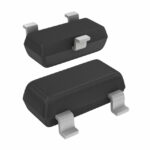 BFR540,235
The activity of extra discounts on wholesale prices is in full swing…
Please fill in your contact information and we will send you the latest wholesale price list.







