ChipApex | Global Electronic Components Supplier
SEARCH
Search Product
Search Post
— IC芯片 | 连接器 | 传感器 | 被动器件 —
Search productSearch post
— IC芯片 | 连接器 | 传感器 | 被动器件 —
Consult the customer manager about the wholesale price.
consultation hotline:86-132-6715-2157
email:[email protected]
Contact the product manager for consultation. One-stop consultation is available.
Do you want a lower wholesale price? Please send us your inquiry and we will reply immediately.
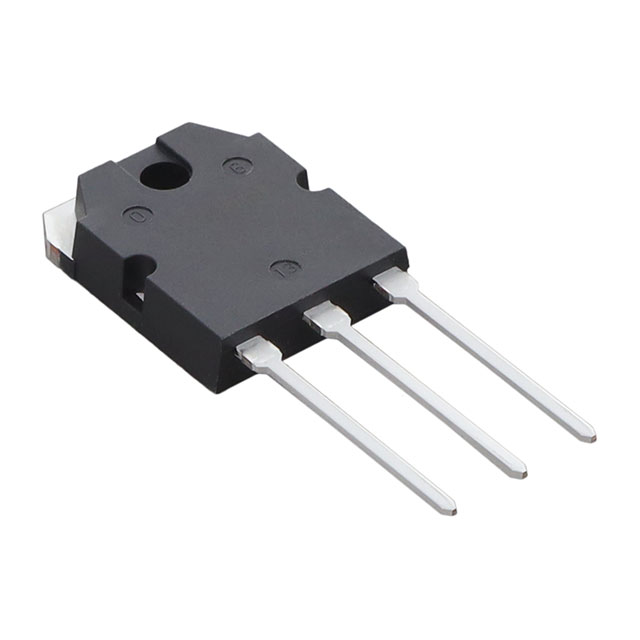
The GT50J341 is a silicon N-channel IGBT from Toshiba Semiconductor and Storage, designed for current-resonant inverter switching applications. It features a TO-3P(N) flange-mount package with an isolated case connection. The device supports a collector-emitter voltage of 600 V and a continuous collector current of 50 A at 25°C, with a peak current rating of 100 A. Key electrical parameters include a typical saturation voltage of 1.6 V and a fall time of 0.15 µs. Thermal resistance from junction to case is 0.75 °C/W for the IGBT and 1.8 °C/W for the integrated FRD. Operating temperatures range from -55°C to +175°C.
Verify component authenticity by checking manufacturer markings against official datasheet specifications. Confirm RoHS compliance status directly with Toshiba sales representatives as indicated in documentation. Ensure proper electrostatic discharge precautions are observed during handling due to device sensitivity. Validate thermal management designs against absolute maximum ratings to prevent thermorunaway.
Select this component specifically for current-resonant inverter circuits where high-speed switching and low conduction losses are required. Evaluate thermal resistance values against system heat dissipation capabilities. Consider the integrated FRD characteristics when designing resonant tank circuits. Verify that operating conditions remain within the specified safe operating area limits.
This discrete IGBT belongs to Toshiba's sixth-generation silicon N-channel series. It utilizes the TO-3P(N) package style, also known as TO-3PN, which provides a robust mechanical structure suitable for high-power applications. The device integrates a fast recovery diode, eliminating the need for external parallel diodes in certain configurations.
No public confirmed substitute part numbers are documented in the provided source material.
The product is dedicated exclusively to current-resonant inverter switching applications.
Yes, it includes a Fast Recovery Diode (FRD) connected between the emitter and collector.
The maximum junction temperature is 175°C.
 GT50J341,Q
The activity of extra discounts on wholesale prices is in full swing…
Please fill in your contact information and we will send you the latest wholesale price list.