 ChipApex | Global Electronic Components Supplier
SEARCH
Search Product
Search Post
— IC芯片 | 连接器 | 传感器 | 被动器件 —
Search productSearch post
— IC芯片 | 连接器 | 传感器 | 被动器件 —
Consult the customer manager about the wholesale price.
consultation hotline:86-132-6715-2157
email:[email protected]
Contact the product manager for consultation. One-stop consultation is available.
Do you want a lower wholesale price? Please send us your inquiry and we will reply immediately.
The onsemi J309 is an N-channel depletion mode Junction Field-Effect Transistor (JFET) designed for VHF and UHF amplifier applications. It operates within a Drain-Source Voltage (VDS) of 25 Vdc and a Gate-Source Voltage (VGS) of 25 Vdc, with a total device dissipation of 350 mW at 25°C ambient temperature. The junction temperature range spans from -65°C to +125°C. Electrical characteristics include a zero-gate-voltage drain current (IDSS) ranging from 12 mA to 30 mA and a gate-source cutoff voltage (VGS(off)) between -1.0 V and -4.0 V. At 100 MHz, the common-gate power gain reaches approximately 16 dB, while the forward transconductance (gfs) ranges from 10,000 µmhos to 20,000 µmhos at 1.0 kHz.
Verify the specific ordering suffix when purchasing. The standard J309 designation refers to the leaded package variant. For lead-free compliance, confirm the presence of the 'G' suffix (e.g., J309G). Ensure the package style matches the required pinout configuration, as Style 5 corresponds to the Drain-Source-Gate arrangement specified in the datasheet marking diagram.
Select the J309 for designs requiring stable N-channel depletion behavior in radio frequency environments. Compare IDSS and VGS(off) tolerances against circuit biasing requirements. Consider thermal derating above 25°C due to the 2.8 mW/°C limit. Verify that the TO-92 package dimensions align with the PCB footprint constraints and that the operating frequency range falls within the validated S-parameter data provided.
The J309 belongs to the J3xx series of N-channel JFETs manufactured by onsemi. It shares the same physical package and general electrical architecture as the J310, though they differ in specific parameter bins such as IDSS and VGS(off) ranges. This component is part of onsemi's legacy discrete transistor portfolio, maintained for compatibility with established VHF/UHF hardware designs.
Public documentation confirms the J309G as the direct lead-free equivalent. Other manufacturers produce functionally similar parts, but cross-referencing requires verifying pinout compatibility and ensuring electrical parameters meet the original design specifications.


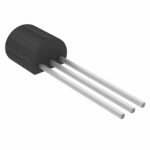 J309
J309
The activity of extra discounts on wholesale prices is in full swing…
Please fill in your contact information and we will send you the latest wholesale price list.



