ChipApex | Global Electronic Components Supplier
SEARCH
Search Product
Search Post
— IC芯片 | 连接器 | 传感器 | 被动器件 —
Search productSearch post
— IC芯片 | 连接器 | 传感器 | 被动器件 —
Consult the customer manager about the wholesale price.
consultation hotline:86-132-6715-2157
email:[email protected]
Contact the product manager for consultation. One-stop consultation is available.
Do you want a lower wholesale price? Please send us your inquiry and we will reply immediately.
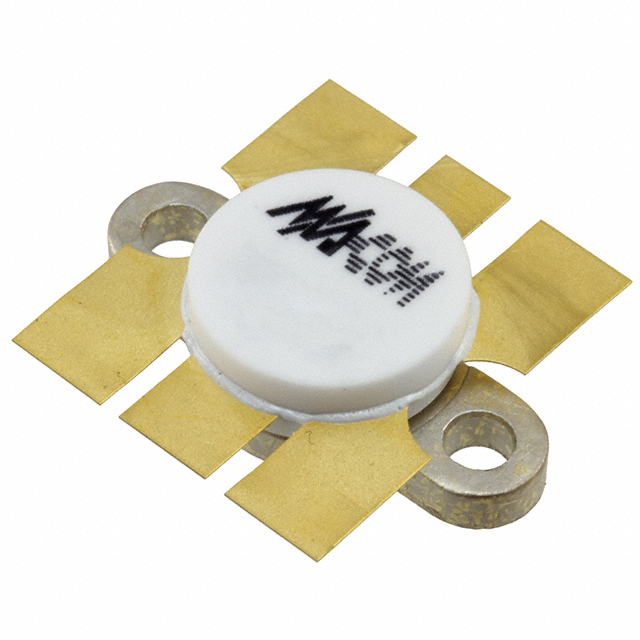
The MRF173CQ is an N-channel enhancement mode RF MOSFET designed for VHF power amplifier applications. It operates up to a frequency range of 200 MHz with a rated output power of 80 W at 150 MHz and 28 V. The device provides a typical gain of 13 dB and minimum efficiency of 55%. It features low thermal resistance, ruggedness tested at rated output power, and nitride passivated die for enhanced reliability. The typical noise figure is 1.5 dB at 2.0 A and 150 MHz.
Verify the specific datasheet revision (Rev. V1) against current MACOM documentation before finalizing designs. Confirm that the Case 316-01, Style 2 package dimensions match your mechanical constraints. Ensure the gate bias circuitry supports the required quiescent drain current characteristics for optimal performance in your intended application environment.
Select this component when designing amplifiers requiring high gain and broadband performance up to 200 MHz. The device is optimized for VHF power amplifier applications where solid-state solutions are preferred over vacuum tubes. Consider its immunity to thermal runaway and ability to withstand severely mismatched loads without damage during system integration.
This part belongs to the MACOM RF MOSFET Line, specifically engineered for VHF power amplifier applications. It utilizes a vertical structure with a planar design, avoiding processing difficulties associated with V-groove power FETs. The product line emphasizes high gain, low noise, and simple bias systems for robust RF performance.
Consult MACOM's official substitution guide or contact technical support for verified equivalent parts. Do not assume cross-compatibility with other RF MOSFETs based on similar specifications alone.
The MRF173CQ was characterized at IDQ = 50 mA, which is the suggested minimum value. For linear amplification, IDQ may need adjustment to optimize critical parameters.
Power output can be varied from its rated value down to zero by varying the DC gate voltage, facilitating manual gain control, AGC/ALC, and modulation systems.
Yes, major advantages of this RF power FET include relative immunity from thermal runaway and the ability to withstand severely mismatched loads without suffering damage.
 MRF173CQ
The activity of extra discounts on wholesale prices is in full swing…
Please fill in your contact information and we will send you the latest wholesale price list.