ChipApex | Global Electronic Components Supplier
SEARCH
Search Product
Search Post
— IC芯片 | 连接器 | 传感器 | 被动器件 —
Search productSearch post
— IC芯片 | 连接器 | 传感器 | 被动器件 —
Consult the customer manager about the wholesale price.
consultation hotline:86-132-6715-2157
email:[email protected]
Contact the product manager for consultation. One-stop consultation is available.
Do you want a lower wholesale price? Please send us your inquiry and we will reply immediately.
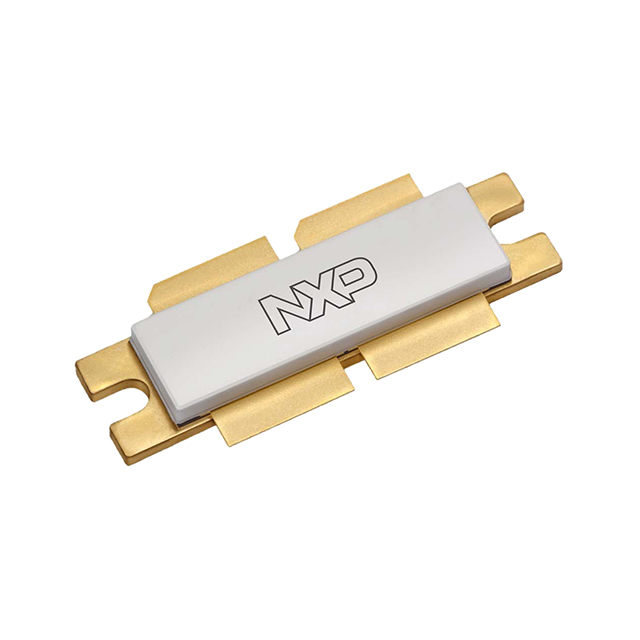
The MRFX1K80HR5 is an NXP Semiconductors RF Power LDMOS Transistor designed for high ruggedness applications. It operates within a frequency range of 1.8 to 400 MHz and supports up to 1800 W continuous wave output at 65 V drain-source voltage. The device features unmatched input and output designs, allowing wide frequency utilization in single-ended or push-pull configurations. Qualified for maximum 65 V operation, it includes integrated ESD protection and is supplied in the NI-1230H-4S package with an R5 suffix indicating 50 units per 56 mm tape on a 13-inch reel.
Verify the R5 ordering suffix confirms the specific packaging configuration of 50 units on a 56 mm tape width within a 13-inch reel. Ensure compatibility with the NI-1230H-4S air cavity ceramic package dimensions and thermal requirements. Confirm that the application environment respects the maximum ratings for drain-source voltage and junction temperature to maintain device longevity and performance standards.
Select this component for designs requiring high power density and broad bandwidth without internal matching networks. The 65 V rating allows for higher output impedance compared to 50 V devices, simplifying broadband matching. Consider the thermal resistance characteristics when designing heatsinking solutions. Verify pin-to-pin compatibility if replacing older 50 V LDMOS variants to facilitate PCB design reuse.
This part belongs to the MRFX series of 65 V LDMOS transistors from NXP Semiconductors. The series utilizes advanced lateral diffusion metal oxide semiconductor technology to deliver high output power while maintaining reasonable output impedance. The MRFX1K80H variant specifically targets wideband applications, offering robust performance across multiple frequency bands suitable for demanding RF power amplifier architectures.
The over-molded plastic package version MRFX1K80N offers lower thermal resistance but requires verification of mechanical fit. Previous generation 50 V LDMOS transistors may serve as functional substitutes if board layout permits, though impedance matching will differ significantly due to voltage scaling.
 MRFX1K80HR5
The activity of extra discounts on wholesale prices is in full swing…
Please fill in your contact information and we will send you the latest wholesale price list.