 ChipApex | Global Electronic Components Supplier

SEARCH
Search Product
Search Post
— IC芯片 | 连接器 | 传感器 | 被动器件 —
Search productSearch post
— IC芯片 | 连接器 | 传感器 | 被动器件 —
Consult the customer manager about the wholesale price.
consultation hotline:86-132-6715-2157
email:[email protected]
Contact the product manager for consultation. One-stop consultation is available.
Do you want a lower wholesale price? Please send us your inquiry and we will reply immediately.
SN74HCT564N is listed in the Flip Flops range at ChipApex. The manufacturer field lists Texas Instruments. Its product description is IC FF D-TYPE SNGL 8BIT 20DIP. Review the specifications below when checking this part for your BOM.
The SN74HCT564N is an octal D-type edge-triggered flip-flop with inverting outputs and three-state control, manufactured by Texas Instruments. It operates within a supply voltage range of 4.5 V to 5.5 V. The device features a propagation delay of 10.5 ns and provides high-level output current of -24 mA and low-level output current of 24 mA. Designed for through-hole mounting, it utilizes a PDIP-20 package. The component supports TTL input levels and functions across an operating temperature range from -40°C to +85°C.
Verify that the specific part number matches the required through-hole PDIP-20 package configuration. Confirm that the operating temperature range of -40°C to +85°C aligns with the environmental requirements of the target application. Ensure compatibility with the 4.5 V to 5.5 V power supply specifications before integration into the design.
Select this component when an octal flip-flop with inverting outputs and three-state control is required for through-hole assembly. The HCT series ensures TTL compatibility while maintaining CMOS noise immunity. Consider the 10.5 ns propagation delay and ±24 mA drive strength for signal integrity in high-speed digital designs requiring robust output capabilities.
This component belongs to the Texas Instruments 74HCT logic family, which combines the speed of advanced CMOS technology with TTL-compatible input thresholds. The SN74HCT564N specifically addresses applications needing multiple synchronized storage elements with tri-state output control, facilitating efficient data management in complex digital architectures.
SN74HCT564DR (Texas Instruments, SOIC-20)
The outputs are inverting, meaning the Q output is the logical complement of the D input state at the time of the clock edge.
Yes, the three-state output feature allows the device to be directly connected to bus lines, enabling multiple devices to share the same data path.
Explore related parts through Logic, Integrated Circuits (ICs), all product categories, ChipApex homepage.
 SN74HCT564N

SN74HCT564N is listed in the Flip Flops range at ChipApex. The manufacturer field lists Texas Instruments. Its product description is IC FF D-TYPE SNGL…
Read More
SN74HCT564N is listed in the Flip Flops range at ChipApex. The manufacturer field lists Texas Instruments. Its product description is IC FF D-TYPE SNGL…
Read More
SN74HCT564N is listed in the Flip Flops range at ChipApex. The manufacturer field lists Texas Instruments. Its product description is IC FF D-TYPE SNGL…
Read More
SN74HCT564N is listed in the Flip Flops range at ChipApex. The manufacturer field lists Texas Instruments. Its product description is IC FF D-TYPE SNGL…
Read More
SN74HCT564N is listed in the Flip Flops range at ChipApex. The manufacturer field lists Texas Instruments. Its product description is IC FF D-TYPE SNGL…
Read More
SN74HCT564N is listed in the Flip Flops range at ChipApex. The manufacturer field lists Texas Instruments. Its product description is IC FF D-TYPE SNGL…
Read More
Compare Pt100 and Pt1000 RTDs, two-, three- and four-wire connections, excitation and self-heating. Build an error budget from element to reported temperature.
Read More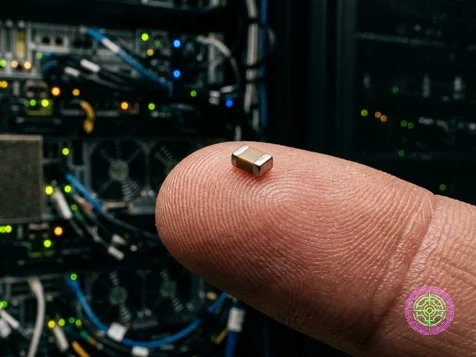
SN74HCT564N is listed in the Flip Flops range at ChipApex. The manufacturer field lists Texas Instruments. Its product description is IC FF D-TYPE SNGL…
Read More
SN74HCT564N is listed in the Flip Flops range at ChipApex. The manufacturer field lists Texas Instruments. Its product description is IC FF D-TYPE SNGL…
Read More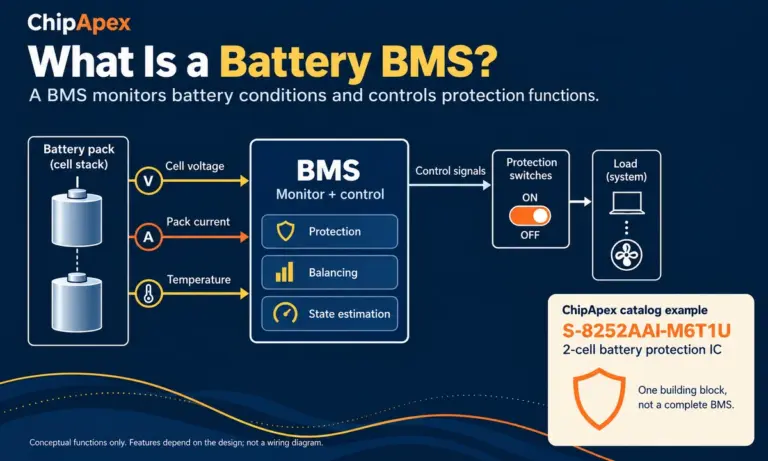
Learn what a battery BMS does, how protection differs from charging, and which pack specifications to check when sourcing BMS components through ChipApex.
Read More
SN74HCT564N is listed in the Flip Flops range at ChipApex. The manufacturer field lists Texas Instruments. Its product description is IC FF D-TYPE SNGL…
Read More
Understand how oscillators generate timing signals, how they differ from crystals, and which frequency, output and stability specs matter when choosing one.
Read More
The activity of extra discounts on wholesale prices is in full swing…
Please fill in your contact information and we will send you the latest wholesale price list.





