 ChipApex | Global Electronic Components Supplier

SEARCH
Search Product
Search Post
— IC芯片 | 连接器 | 传感器 | 被动器件 —
Search productSearch post
— IC芯片 | 连接器 | 传感器 | 被动器件 —
Consult the customer manager about the wholesale price.
consultation hotline:86-132-6715-2157
email:[email protected]
Contact the product manager for consultation. One-stop consultation is available.
Do you want a lower wholesale price? Please send us your inquiry and we will reply immediately.
SN74LV374ATPWT is listed in the Flip Flops range at ChipApex. The manufacturer field lists Texas Instruments. Its product description is IC FF D-TYPE SNGL 8BIT 20TSSOP. Review the specifications below when checking this part for your BOM.
The SN74LV374ATPWT is an octal D-type flip-flop manufactured by Texas Instruments, featuring positive-edge triggering and three-state outputs. It operates within a supply voltage range of 2V to 5.5V and supports a maximum clock frequency of 170MHz. The device exhibits a typical propagation delay of 10.1ns at 5V with 50pF load and draws a static current of 20µA. Outputs provide 16mA drive capability in both high and low states. It is housed in a 20-TSSOP package and functions reliably across an industrial temperature range of -40°C to 85°C.
Verify the specific suffix 'TPWT' against official manufacturer documentation to confirm tape-and-reel packaging specifications and moisture sensitivity level. Ensure the component meets RoHS compliance requirements for your assembly process. Cross-reference the full part number with authorized distributors to confirm availability and authenticity before procurement.
Select this component when designing systems requiring octal data storage with wide voltage flexibility. The LV series offers lower power consumption compared to standard CMOS alternatives. Consider the 170MHz speed rating for high-frequency clock domains. Verify that the TSSOP package dimensions fit your PCB layout constraints and thermal management requirements.
This device belongs to the Texas Instruments SN74LV374A family of octal edge-triggered flip-flops. It is designed for low-voltage CMOS applications, offering performance comparable to standard TTL devices while consuming significantly less power. The family is widely used in general-purpose digital logic designs requiring reliable data latching and bus interfacing capabilities.
SN74LV374APWR: Same logical function and pinout but in a Tape & Reel (R) package instead of Tube (T).
The device supports a maximum clock frequency of 170MHz under specified conditions.
No, the outputs are non-inverting and feature three-state control.
Explore related parts through Logic, Integrated Circuits (ICs), all product categories, ChipApex homepage.
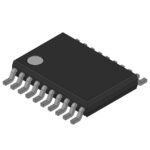 SN74LV374ATPWT
SN74LV374ATPWT is listed in the Flip Flops range at ChipApex. The manufacturer field lists Texas Instruments. Its product description is IC FF D-TYPE SNGL…
Read More
SN74LV374ATPWT is listed in the Flip Flops range at ChipApex. The manufacturer field lists Texas Instruments. Its product description is IC FF D-TYPE SNGL…
Read More
SN74LV374ATPWT is listed in the Flip Flops range at ChipApex. The manufacturer field lists Texas Instruments. Its product description is IC FF D-TYPE SNGL…
Read More
SN74LV374ATPWT is listed in the Flip Flops range at ChipApex. The manufacturer field lists Texas Instruments. Its product description is IC FF D-TYPE SNGL…
Read More
SN74LV374ATPWT is listed in the Flip Flops range at ChipApex. The manufacturer field lists Texas Instruments. Its product description is IC FF D-TYPE SNGL…
Read More
SN74LV374ATPWT is listed in the Flip Flops range at ChipApex. The manufacturer field lists Texas Instruments. Its product description is IC FF D-TYPE SNGL…
Read More
SN74LV374ATPWT is listed in the Flip Flops range at ChipApex. The manufacturer field lists Texas Instruments. Its product description is IC FF D-TYPE SNGL…
Read More
SN74LV374ATPWT is listed in the Flip Flops range at ChipApex. The manufacturer field lists Texas Instruments. Its product description is IC FF D-TYPE SNGL…
Read More
SN74LV374ATPWT is listed in the Flip Flops range at ChipApex. The manufacturer field lists Texas Instruments. Its product description is IC FF D-TYPE SNGL…
Read More
SN74LV374ATPWT is listed in the Flip Flops range at ChipApex. The manufacturer field lists Texas Instruments. Its product description is IC FF D-TYPE SNGL…
Read More
Learn what an integrated circuit is, how ICs work, the main types and the specs to check before choosing a part for your design…
Read More
Understand how a comparator switches at a voltage threshold, why hysteresis prevents chatter, and which output and input specs matter.
Read More
The activity of extra discounts on wholesale prices is in full swing…
Please fill in your contact information and we will send you the latest wholesale price list.





