 ChipApex | Global Electronic Components Supplier
SEARCH
Search Product
Search Post
— IC芯片 | 连接器 | 传感器 | 被动器件 —
Search productSearch post
— IC芯片 | 连接器 | 传感器 | 被动器件 —
The trend of science and technology is changing rapidly.
In the embedded world, general-purpose CPUs are great at running operating systems, and MCUs excel at logic control. But when you need to process audio, video, or sensor data in real-time, neither is truly efficient. This is where the DSP (Digital Signal Processor) comes in.
Think of a CPU as a versatile Swiss Army knife, while a DSP is a high-speed industrial blender. If you need to chop a few vegetables (logic control), the knife works fine. But if you need to blend a massive amount of ingredients instantly (real-time signal processing), you need the specialized power of the blender.
This guide breaks down what a DSP is, why its architecture is fundamentally different from a standard microcontroller, and how to select the right chip for your high-performance signal processing needs.
A DSP is a specialized microprocessor optimized for mathematical operations. Its primary job is to take real-world analog signals (like sound from a microphone or vibration from a motor), convert them into digital data, and perform heavy mathematical calculations on them in real-time.
The magic lies in its architecture. Unlike a standard CPU that fetches data and instructions over the same path (Von Neumann architecture), most DSPs use a Harvard Architecture. This means they have separate buses for data and instructions, allowing the chip to read an instruction and fetch two pieces of data simultaneously.
Combined with a dedicated Hardware Multiplier-Accumulator (MAC), a DSP can perform a multiplication and an addition in a single clock cycle. This is the core operation behind almost every signal processing algorithm, such as Finite Impulse Response (FIR) filters and Fast Fourier Transforms (FFT).
You might wonder, “Can’t I just use a fast ARM Cortex-M MCU to filter audio?” Technically yes, but it’s highly inefficient.
| Feature | Standard MCU (e.g., Cortex-M) | DSP (e.g., TI C6000, ADI SHARC) |
|---|---|---|
| Core Strength | Logic control, Interrupt handling | Heavy math (MAC operations) |
| Architecture | Von Neumann (Shared bus) | Harvard (Separate data/instruction buses) |
| Math Efficiency | Multiple cycles per multiply-add | Single cycle per multiply-add |
| Power Efficiency | Lower for control tasks | Much higher for signal processing |
| Typical Use | Reading sensors, toggling GPIO | Audio codecs, Motor control (FOC), Radar |
Engineering Insight: If your application involves complex algorithms like noise cancellation, image enhancement, or motor vector control, a general-purpose MCU will spend 90% of its time crunching numbers and might still miss real-time deadlines. A DSP handles these tasks with ease, often at a fraction of the power consumption.
In modern electronics, you won’t always find a standalone DSP chip. To save board space and cost, many manufacturers now integrate DSP cores directly into larger System-on-Chips (SoCs).
For example, a smartphone processor might have powerful ARM cores for running Android, but it also includes a specialized “Hexagon” DSP or an Image Signal Processor (ISP) to handle camera data and voice commands while the main CPU sleeps. This hybrid approach gives designers the best of both worlds: high-level control and specialized processing power.
When selecting a DSP, one of the most critical decisions is choosing between Fixed-Point and Floating-Point architectures.
Pro Tip: For high-fidelity audio or complex radar imaging, always opt for Floating-Point. For simple motor control or voice compression, Fixed-Point is often sufficient and more cost-effective.
Whether you need a standalone DSP for a rugged industrial controller or a hybrid SoC with integrated DSP capabilities for a consumer device, ChipApex stocks the industry’s most reliable processing solutions.
We carry a wide selection of digital signal processors from top manufacturers like Texas Instruments (C2000, C6000 series), Analog Devices (SHARC, Blackfin), and NXP.
Why source with us?
Search our inventory by full part number (e.g., TMS320F28335PGFA, TMS320C6748EZWT3, ADSP-21489KSWZ-3B) and unlock real-time performance for your next design.
Discover what DRAM is, how it works, its types, and why choosing authentic, RoHS-compliant DRAM chips matters. Source reliable DRAM from ChipApex—global supplier with full traceability.
View details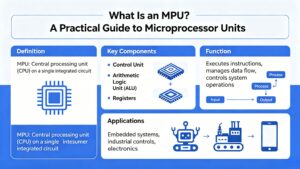
Navigate the MPU landscape (NXP, TI, ST) with our guide. Discover ARM Cortex-A architecture, hidden costs of MPUs, longevity risks, and source authentic industrial-grade MPUs with full BOM support at ChipApex.
View details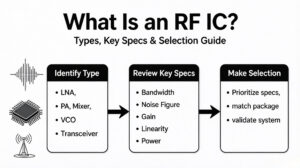
Learn what an RF IC is, how LNAs, PAs, mixers, attenuators and transceivers differ, and how to choose the right RF component. Includes verified part numbers and layout tips.
View details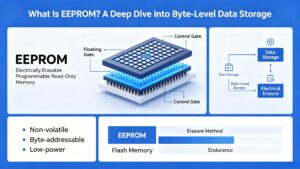
What is EEPROM? Learn byte-level storage, EEPROM vs Flash, I2C/SPI, BOM selection & sourcing risks. Authentic EEPROMs at ChipApex.
View details
The activity of extra discounts on wholesale prices is in full swing…
Please fill in your contact information and we will send you the latest wholesale price list.