 ChipApex | Global Electronic Components Supplier

SEARCH
Search Product
Search Post
— IC芯片 | 连接器 | 传感器 | 被动器件 —
Search productSearch post
— IC芯片 | 连接器 | 传感器 | 被动器件 —
The trend of science and technology is changing rapidly.
Motion sensors detect changes within a monitored area and convert them into an electrical signal or event. Different technologies observe different changes: PIR sensors respond to changing infrared energy, radar observes reflected radio signals, and ultrasonic sensors use sound. The sensing method, optics, processing and installation determine which movements the system can detect.
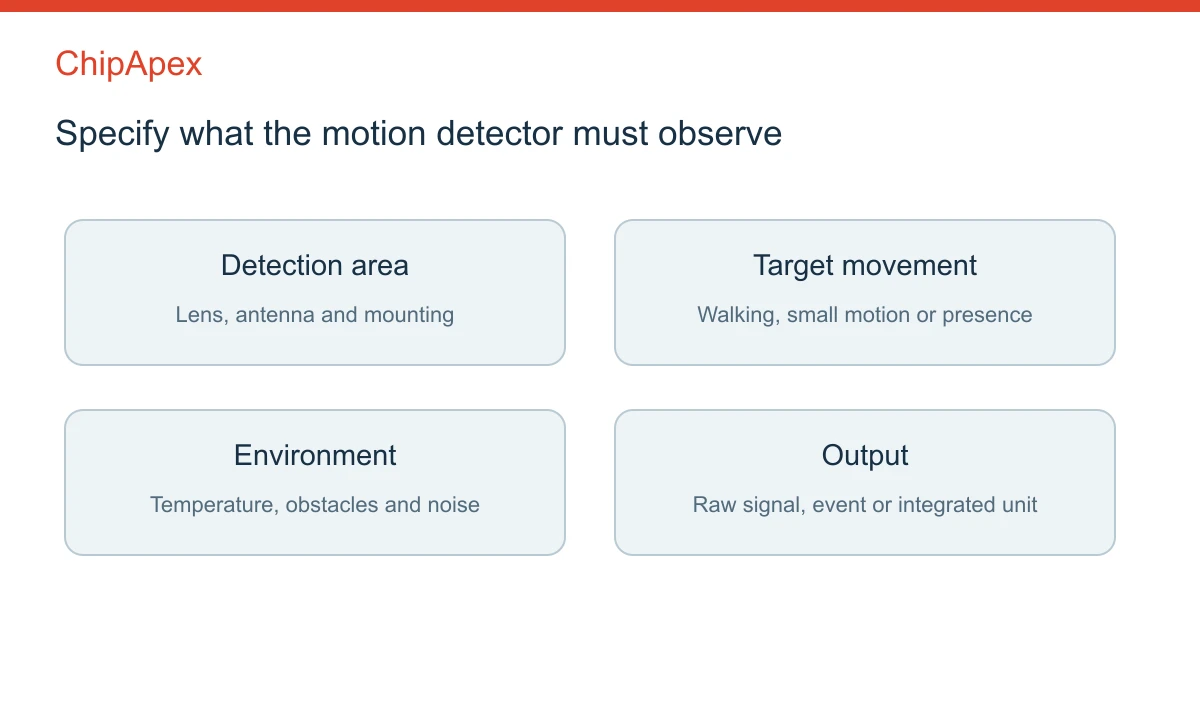
A detector that notices someone walking through a corridor may not reliably identify a person sitting quietly at a desk. Start with the required event, detection area and acceptable response time before choosing the sensor or adjusting a sensitivity control.
A passive infrared sensor receives infrared energy from its field of view. In a common motion-detection arrangement, changes across sensing elements produce a signal as a warm target moves between viewing zones. A lens or other optical arrangement shapes those zones. The sensor does not transmit a beam to illuminate the room.
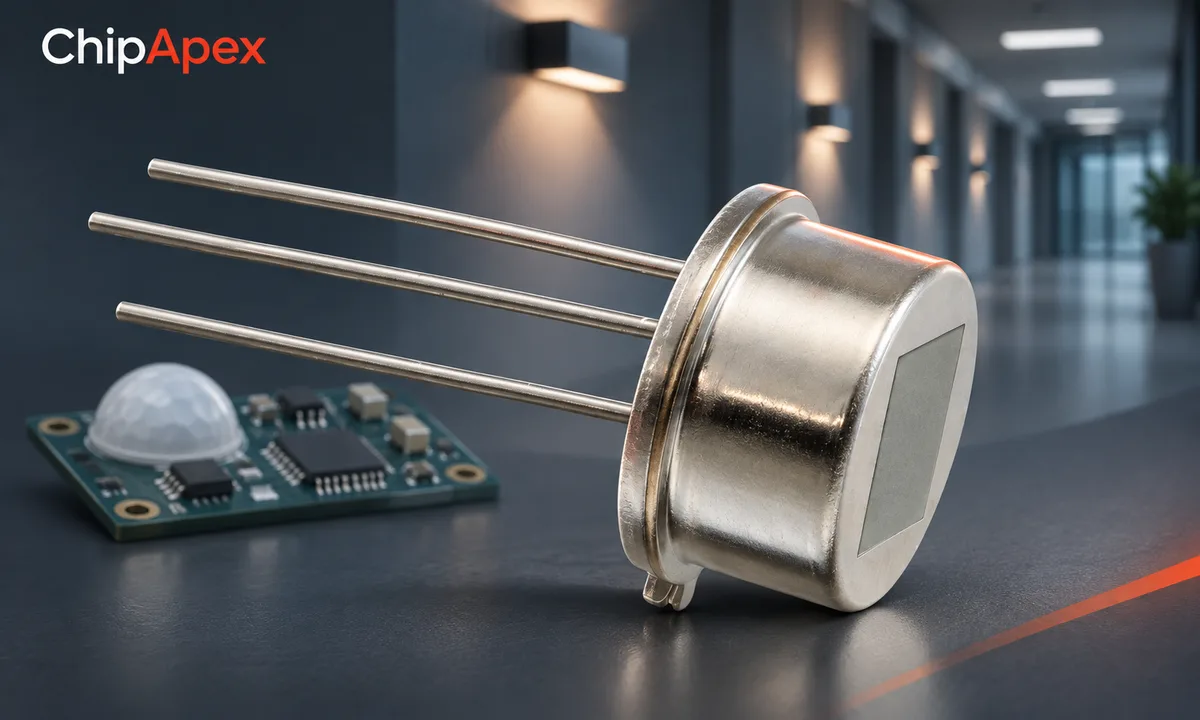
The package shown in a catalog may be a sensing element, while a finished detector can include a lens, signal conditioning, processing and a power interface. These are different levels of integration. When comparing motion detectors, confirm whether the listed item supplies a raw analog signal, a digital event output or a complete detector function.
PIR response depends on the changing infrared scene. Target direction, speed, thermal contrast, lens geometry and mounting affect detection. A nominal range measured with one walking target under stated conditions does not guarantee the same response to every person, position or environment. Panasonic's PIR information in the sources explains the underlying passive detection principle.
Radar transmits radio-frequency energy and processes reflections. A Doppler arrangement can detect motion through changes associated with relative movement. Other radar architectures can estimate range or angle when the hardware and processing support those functions. The term radar does not establish every one of those capabilities.
Ultrasonic detection transmits sound and evaluates its return. Depending on the system, it may observe changes in echoes, timing or frequency. Air movement, acoustic interference, target geometry and absorption can influence performance. Its coverage should be tested in the intended room or enclosure.
| Technology | What it observes | Important selection limit |
|---|---|---|
| PIR | Changes in received infrared energy across viewing zones | Thermal contrast, optics and movement pattern |
| Radar | Reflected radio signals and supported motion/range features | Antenna pattern, processing, reflections and installation materials |
| Ultrasonic | Reflected sound | Acoustic environment, obstruction and target geometry |
| Image-based detection | Changes in image data | Lighting, occlusion, processing and privacy requirements |
Some optical sensors detect a beam interruption or reflected light from a target. That function differs from a room-scale PIR detector even when both use optical energy. Select against the intended event and geometry rather than grouping every optical device under motion detection.
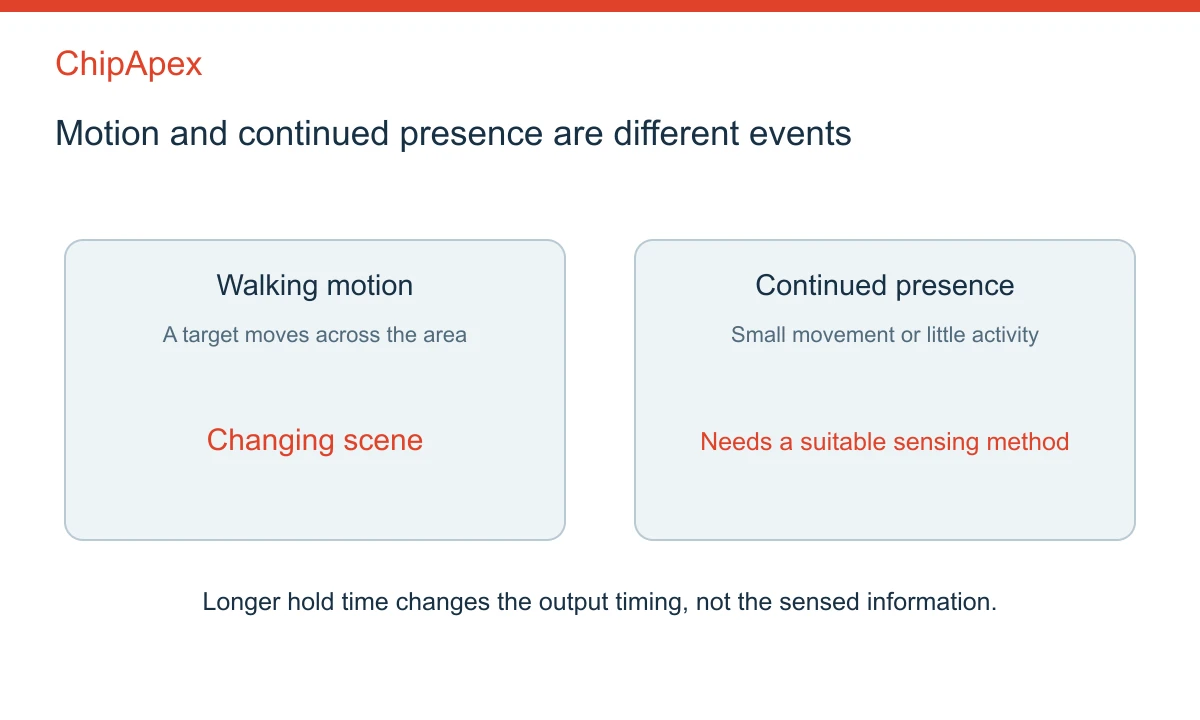
Movement through a detection area and continued occupancy are different requirements. A basic PIR event may indicate recent movement while offering limited evidence about a person who then remains still. Increasing the hold time keeps a light on longer, but it does not create additional sensing information.
Some radar systems use small movements, including motion associated with breathing, to infer presence. That depends on signal quality, location, processing and configuration. It should not be generalized to every microwave module or described as guaranteed detection of a perfectly motionless target. Infineon's presence-sensing material describes a specific radar approach rather than a universal radar specification.
Dual-technology detectors combine information from more than one sensing method. An AND rule can reduce some false triggers but may miss an event when one channel cannot detect it. An OR rule can increase event sensitivity while accepting more unwanted activations. The fusion rule and its timing window need to match the application.
A raw PIR output may need amplification, filtering and threshold detection. The analog front end must preserve the slow signal changes of interest while limiting noise and disturbances that could cause false events. Gain alone does not decide detection performance.
Filter bandwidth, comparator thresholds, hysteresis and processing windows determine which changes become events. Raising sensitivity can also increase susceptibility to noise. Startup settling deserves a separate check, because a circuit that is stable after several minutes may generate unwanted events immediately after power-up.
Supply noise can enter the measurement path. A suitable low dropout regulator circuit may help with a particular supply requirement, but it does not remove every interference path. PCB routing, grounding and sensor placement also contribute.
TI's low-noise PIR reference design explains the relationship between filtering, settling and false triggers. Its dual-PIR reference design provides another perspective: spatially distinct sensing channels can supply information for event classification. Published results from those boards do not establish the behavior of a different sensor or a ChipApex product.
Mounting height, orientation and the lens pattern define which paths cross sensitive viewing zones. Test expected approaches, not just one walk directly in front of the sensor. Furniture and partitions can obstruct the relevant energy path, while nearby equipment can create unwanted changes in the scene.
Ordinary window glass generally prevents a conventional room PIR detector from receiving the long-wave infrared scene it is designed to use. A transparent-looking cover therefore needs material-specific review. A radar housing requires a different assessment because radio-frequency transmission and reflection depend on material and construction.
For outdoor use, evaluate weather, thermal changes, moving vegetation and contamination as appropriate to the sensing method. An indoor detector with a convenient range is not automatically suitable outdoors. Follow the exact sensor and enclosure guidance rather than transferring an installation rule from a different technology.
Separate event generation from event delivery. A local detection may fail to appear in an app because of communication or software behavior. For troubleshooting, observe the sensor output, processing result and network delivery as separate stages. This helps distinguish a coverage problem from a notification problem.
No. PIR sensors respond to changing infrared energy, while radar and ultrasonic sensors use different physical signals. Image-based detection uses changes in camera data. Even within one technology, optics, processing and configuration change behavior. Identify the sensing method before applying assumptions about temperature, walls or target visibility.
Small movements may trigger some arrangements, but reliable continued occupancy should not be assumed. PIR motion sensing depends on changes in the received infrared scene. Test the actual sitting positions and activities, and consider a presence-sensing method suited to that requirement if movement is too small or infrequent.
Possible causes include environmental changes, supply or signal-chain noise, a changing view, unsuitable thresholds or another moving target. Which causes are plausible depends on the technology. Record when the event occurs and compare sensor output with power, temperature and surrounding activity rather than changing sensitivity without a diagnosis.
The answer depends on the sensing method and material. A conventional PIR arrangement generally cannot observe the intended long-wave infrared scene through ordinary glass. Radar may interact with some nonmetallic materials differently, but transmission, reflections and detection beyond the intended boundary must be assessed for the specific installation.
A raw sensing element generally needs suitable signal conditioning, processing and a load interface. A complete detector may integrate more of those functions, subject to its ratings. Confirm the supplied component's output and power requirements; its appearance or number of leads does not establish compatibility with a lighting load.
For ChipApex, describe whether the goal is walking-motion detection, small-motion presence or another event. Include the detection area, mounting constraints, environment, supply, output interface and standby-power target. Identify whether you need a sensing element or a more integrated component so the inquiry matches the system being designed.
Learn what a shift register does, how bits move and when to use SIPO or PISO devices. Review latch timing, logic levels, output drive and daisy chaining.
View details
Learn how a TRIAC switches AC loads. Understand triggering, latching, holding current, phase control and thermal limits before choosing a component.
View details
Select power transformers by input frequency, secondary VA, rectifier load, isolation, regulation and inrush. Build a clearer specification for your next RFQ.
View details
Stop guessing which Op-Amp to use. We break down GBWP, Slew Rate, and Offset Voltage with real engineering insights. Find the right parts like NE5532DR & LM358DR at ChipApex.
View details
The activity of extra discounts on wholesale prices is in full swing…
Please fill in your contact information and we will send you the latest wholesale price list.

