 ChipApex | Global Electronic Components Supplier

SEARCH
Search Product
Search Post
— IC芯片 | 连接器 | 传感器 | 被动器件 —
Search productSearch post
— IC芯片 | 连接器 | 传感器 | 被动器件 —
Consult the customer manager about the wholesale price.
consultation hotline:86-132-6715-2157
email:[email protected]
Contact the product manager for consultation. One-stop consultation is available.
Do you want a lower wholesale price? Please send us your inquiry and we will reply immediately.
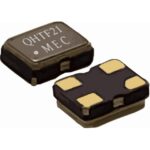
18QHTF21-30.320-PD is listed in the Oscillators range at ChipApex. The manufacturer field lists Mercury Electronics Ind. Co. Ltd. Its product description is 30.32 MHz XO 1.8V 2.0X1.6 MM PD. Review the specifications below when checking this part for your BOM.
The 18QHTF21-30.320-PD is a standard crystal oscillator manufactured by Mercury Electronics Ind. Co. Ltd. It operates at a frequency of 30.32 MHz and utilizes LVCMOS output logic. The device requires a supply voltage of 1.8V and features a power-down function for standby mode control. It is housed in a compact 4-SMD, no-lead package with dimensions of 2.0x1.6 mm. This component is designed for applications requiring precise timing signals within low-voltage digital systems.
Verify the specific frequency tolerance and load capacitance requirements against your circuit design before procurement. Ensure that the 1.8V supply voltage aligns with your system's power rails. Confirm that the 4-SMD no-lead package footprint matches your PCB layout specifications. Check for any RoHS compliance documentation if required by your manufacturing standards.
Select this component when a 30.32 MHz clock signal is required with low voltage operation. Consider the LVCMOS interface compatibility with your target logic family. Evaluate the physical size constraints to ensure the 2.0x1.6 mm package fits within the designated area. Assess the need for power-down capability if energy efficiency during idle states is a priority for the application.
This part belongs to the Mercury Electronics XO series, which provides standard crystal oscillators. The model number indicates a 1.8V supply variant with a 30.32 MHz frequency. Similar parts in the series may offer different frequencies or voltage levels while maintaining the same package style and output logic type.
Direct substitutes must match the 30.32 MHz frequency, 1.8V supply, LVCMOS output, and 4-SMD 2.0x1.6mm package. Verify pinout compatibility and electrical characteristics such as phase noise and jitter if specified in the original design requirements.
Explore related parts through Crystals, Oscillators, Resonators, all product categories, ChipApex homepage.
 18QHTF21-30.320-PD

18QHTF21-30.320-PD is listed in the Oscillators range at ChipApex. The manufacturer field lists Mercury Electronics Ind. Co. Ltd. Its product description is 30.32 MHz…
Read More
18QHTF21-30.320-PD is listed in the Oscillators range at ChipApex. The manufacturer field lists Mercury Electronics Ind. Co. Ltd. Its product description is 30.32 MHz…
Read More
18QHTF21-30.320-PD is listed in the Oscillators range at ChipApex. The manufacturer field lists Mercury Electronics Ind. Co. Ltd. Its product description is 30.32 MHz…
Read More
18QHTF21-30.320-PD is listed in the Oscillators range at ChipApex. The manufacturer field lists Mercury Electronics Ind. Co. Ltd. Its product description is 30.32 MHz…
Read More
18QHTF21-30.320-PD is listed in the Oscillators range at ChipApex. The manufacturer field lists Mercury Electronics Ind. Co. Ltd. Its product description is 30.32 MHz…
Read More
Understand how oscillators generate timing signals, how they differ from crystals, and which frequency, output and stability specs matter when choosing one.
Read More
18QHTF21-30.320-PD is listed in the Oscillators range at ChipApex. The manufacturer field lists Mercury Electronics Ind. Co. Ltd. Its product description is 30.32 MHz…
Read More
18QHTF21-30.320-PD is listed in the Oscillators range at ChipApex. The manufacturer field lists Mercury Electronics Ind. Co. Ltd. Its product description is 30.32 MHz…
Read More
See when an inductor behaves linearly, how DC bias and saturation reduce inductance, and which current and temperature curves to check.
Read More
18QHTF21-30.320-PD is listed in the Oscillators range at ChipApex. The manufacturer field lists Mercury Electronics Ind. Co. Ltd. Its product description is 30.32 MHz…
Read More
Learn why PTC resistance rises with temperature, how it differs from NTC, and which ratings matter for sensing and protection.
Read More
Choose a DIP switch by contact type, coded positions, footprint and signal ratings. Check logic polarity, assembly conditions and PCB configuration behavior.
Read More
The activity of extra discounts on wholesale prices is in full swing…
Please fill in your contact information and we will send you the latest wholesale price list.





