 ChipApex | Global Electronic Components Supplier

SEARCH
Search Product
Search Post
— IC芯片 | 连接器 | 传感器 | 被动器件 —
Search productSearch post
— IC芯片 | 连接器 | 传感器 | 被动器件 —
Consult the customer manager about the wholesale price.
consultation hotline:86-132-6715-2157
email:[email protected]
Contact the product manager for consultation. One-stop consultation is available.
Do you want a lower wholesale price? Please send us your inquiry and we will reply immediately.
SN74AUC2G240DCTR is listed in the Buffers, Drivers, Receivers, Transceivers range at ChipApex. The manufacturer field lists Texas Instruments. Its product description is IC BUFFER INVERT 2.7V SM8. Review the specifications below when checking this part for your BOM.
The SN74AUC2G240DCTR is a dual buffer and line driver from the Texas Instruments AUC logic family. It features two independent channels with inverting logic and three-state outputs. The device operates within a supply voltage range of 0.8 V to 2.7 V. Key electrical parameters include a propagation delay of 1.5 ns at 2.7 V, output drive currents of ±9 mA, and low static current consumption. It is housed in an SM-8 (SC-70) package and supports operation temperatures from -40°C to +85°C.
Verify the specific suffix DCTR indicates the cut-tape or reel packaging configuration upon ordering. Confirm that the 0.8V to 2.7V operating range aligns with the target system's power rails. Ensure the SM-8 package footprint matches the PCB design constraints. Check for RoHS compliance status as required by regional regulations.
Select this component when low voltage operation below 3.3V is required alongside high-speed switching capabilities. The AUC series offers superior speed-to-power efficiency compared to older LVC or LV families. Consider the dual-channel configuration if space is limited and multiple inversion stages are needed. Verify input/output voltage compatibility with the connected logic levels.
This part belongs to the SN74AUC2G240 series, which represents Texas Instruments' advanced ultra-low voltage CMOS technology. The series is designed for portable applications requiring minimal power usage without sacrificing speed. It serves as a compact alternative to octal buffers, offering functional equivalence in a significantly smaller surface-mount package.
The SN74AUP2G240DCUR is a recommended replacement with similar functionality but a wider voltage range up to 3.6V. For pin-compatible alternatives, check the SN74AUC2G240DCUR variant which shares the same package type.
Explore related parts through Logic, Integrated Circuits (ICs), all product categories, ChipApex homepage.
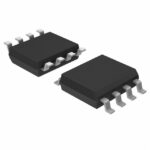 SN74AUC2G240DCTR

Choose a DIP switch by contact type, coded positions, footprint and signal ratings. Check logic polarity, assembly conditions and PCB configuration behavior.
Read More
Select a common mode choke using noise frequency, current, insulation and signal integrity. Understand impedance curves, layout and filter limitations.
Read More
Understand voltage controlled oscillator tuning, phase noise and PLL operation. Check supply noise, output loading and requirements before selection.
Read More
Understand load cell sensor output, bridge wiring and calibration. Learn how mV/V sensitivity, mechanics and ADC noise affect measurement accuracy.
Read More
SN74AUC2G240DCTR is listed in the Buffers, Drivers, Receivers, Transceivers range at ChipApex. The manufacturer field lists Texas Instruments. Its product description is IC BUFFER…
Read More
SN74AUC2G240DCTR is listed in the Buffers, Drivers, Receivers, Transceivers range at ChipApex. The manufacturer field lists Texas Instruments. Its product description is IC BUFFER…
Read More
SN74AUC2G240DCTR is listed in the Buffers, Drivers, Receivers, Transceivers range at ChipApex. The manufacturer field lists Texas Instruments. Its product description is IC BUFFER…
Read More
Learn what an IMU measures, how accelerometers and gyroscopes work together, why orientation estimates drift, and what to compare.
Read More
SN74AUC2G240DCTR is listed in the Buffers, Drivers, Receivers, Transceivers range at ChipApex. The manufacturer field lists Texas Instruments. Its product description is IC BUFFER…
Read More
SN74AUC2G240DCTR is listed in the Buffers, Drivers, Receivers, Transceivers range at ChipApex. The manufacturer field lists Texas Instruments. Its product description is IC BUFFER…
Read More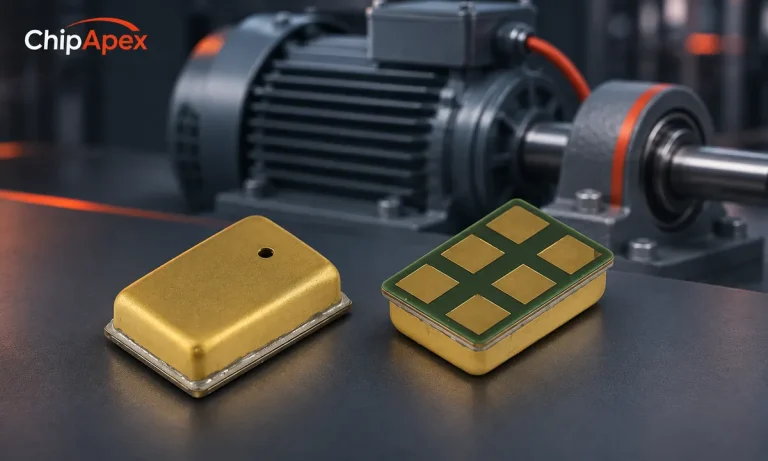
Choose a vibration sensor for machine monitoring. Compare sensing methods, bandwidth, noise and mounting, then define the signal-chain requirements.
Read More
Compare Pt100 and Pt1000 RTDs, two-, three- and four-wire connections, excitation and self-heating. Build an error budget from element to reported temperature.
Read More
The activity of extra discounts on wholesale prices is in full swing…
Please fill in your contact information and we will send you the latest wholesale price list.





