 ChipApex | Global Electronic Components Supplier

SEARCH
Search Product
Search Post
— IC芯片 | 连接器 | 传感器 | 被动器件 —
Search productSearch post
— IC芯片 | 连接器 | 传感器 | 被动器件 —
Consult the customer manager about the wholesale price.
consultation hotline:86-132-6715-2157
email:[email protected]
Contact the product manager for consultation. One-stop consultation is available.
Do you want a lower wholesale price? Please send us your inquiry and we will reply immediately.
SN74LVC112ADR is listed in the Flip Flops range at ChipApex. The manufacturer field lists Texas Instruments. Its product description is IC FF JK TYPE DUAL 1BIT 16SOIC. Review the specifications below when checking this part for your BOM.
The SN74LVC112ADR is a dual negative-edge-triggered J-K flip-flop manufactured by Texas Instruments. It operates within a supply voltage range of 1.65V to 3.6V and supports clock frequencies up to 150MHz. The device features clear and preset functionality, with high-level output current capability of -24 mA. It is housed in a 16-SOIC package (0.154 inch width) and is designed for through-hole or surface-mount applications. Input types include CMOS and TTL compatibility.
Verify the specific ordering suffix 'ADR' confirms the tape-and-reel packaging format and SOIC-16 package variant. Ensure the selected component matches the required voltage and speed specifications for your application. Cross-reference the manufacturer's datasheet for detailed mechanical dimensions and electrical characteristics before finalizing procurement decisions.
Select this component when dual J-K flip-flops are required in a compact SOIC-16 package. Consider the 1.65V to 3.6V operating range for low-voltage digital designs. Verify input compatibility with CMOS or TTL logic levels. Ensure the negative-edge triggering aligns with your system timing requirements and that the 150MHz speed meets performance needs.
This part belongs to Texas Instruments' LVC (Low-Voltage CMOS) logic family, optimized for low-power applications. The SN74LVC112ADR specifically provides two independent J-K flip-flops in a single package. It is commonly used in portable electronics and battery-powered devices due to its wide voltage range and low power consumption characteristics compared to standard CMOS families.
Check for direct pin-compatible alternatives such as the SN74LVC112A without the reel suffix if bulk packaging is preferred. Verify equivalent parts from other manufacturers like ON Semiconductor or NXP that offer similar dual J-K flip-flop functionality in SOIC-16 packages with matching electrical specifications.
Explore related parts through Logic, Integrated Circuits (ICs), all product categories, ChipApex homepage.
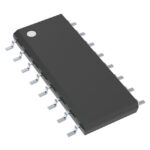 SN74LVC112ADR

SN74LVC112ADR is listed in the Flip Flops range at ChipApex. The manufacturer field lists Texas Instruments. Its product description is IC FF JK TYPE…
Read More
SN74LVC112ADR is listed in the Flip Flops range at ChipApex. The manufacturer field lists Texas Instruments. Its product description is IC FF JK TYPE…
Read More
SN74LVC112ADR is listed in the Flip Flops range at ChipApex. The manufacturer field lists Texas Instruments. Its product description is IC FF JK TYPE…
Read More
SN74LVC112ADR is listed in the Flip Flops range at ChipApex. The manufacturer field lists Texas Instruments. Its product description is IC FF JK TYPE…
Read More
SN74LVC112ADR is listed in the Flip Flops range at ChipApex. The manufacturer field lists Texas Instruments. Its product description is IC FF JK TYPE…
Read More
SN74LVC112ADR is listed in the Flip Flops range at ChipApex. The manufacturer field lists Texas Instruments. Its product description is IC FF JK TYPE…
Read More
SN74LVC112ADR is listed in the Flip Flops range at ChipApex. The manufacturer field lists Texas Instruments. Its product description is IC FF JK TYPE…
Read More
SN74LVC112ADR is listed in the Flip Flops range at ChipApex. The manufacturer field lists Texas Instruments. Its product description is IC FF JK TYPE…
Read More
SN74LVC112ADR is listed in the Flip Flops range at ChipApex. The manufacturer field lists Texas Instruments. Its product description is IC FF JK TYPE…
Read More
SN74LVC112ADR is listed in the Flip Flops range at ChipApex. The manufacturer field lists Texas Instruments. Its product description is IC FF JK TYPE…
Read More
Learn how rectifiers convert AC to DC, compare half-wave and bridge circuits, and select voltage, current, recovery and thermal ratings for your design.
Read More
Understand how oscillators generate timing signals, how they differ from crystals, and which frequency, output and stability specs matter when choosing one.
Read More
The activity of extra discounts on wholesale prices is in full swing…
Please fill in your contact information and we will send you the latest wholesale price list.





