 ChipApex | Global Electronic Components Supplier

SEARCH
Search Product
Search Post
— IC芯片 | 连接器 | 传感器 | 被动器件 —
Search productSearch post
— IC芯片 | 连接器 | 传感器 | 被动器件 —
The trend of science and technology is changing rapidly.
A thermal fuse is a temperature-sensitive device that permanently opens a circuit when it operates. It provides a final interruption during overheating rather than routine temperature control. Selecting one requires its functioning temperature, holding temperature, post-operation limit, electrical ratings and mounting conditions to be evaluated together in the actual equipment.
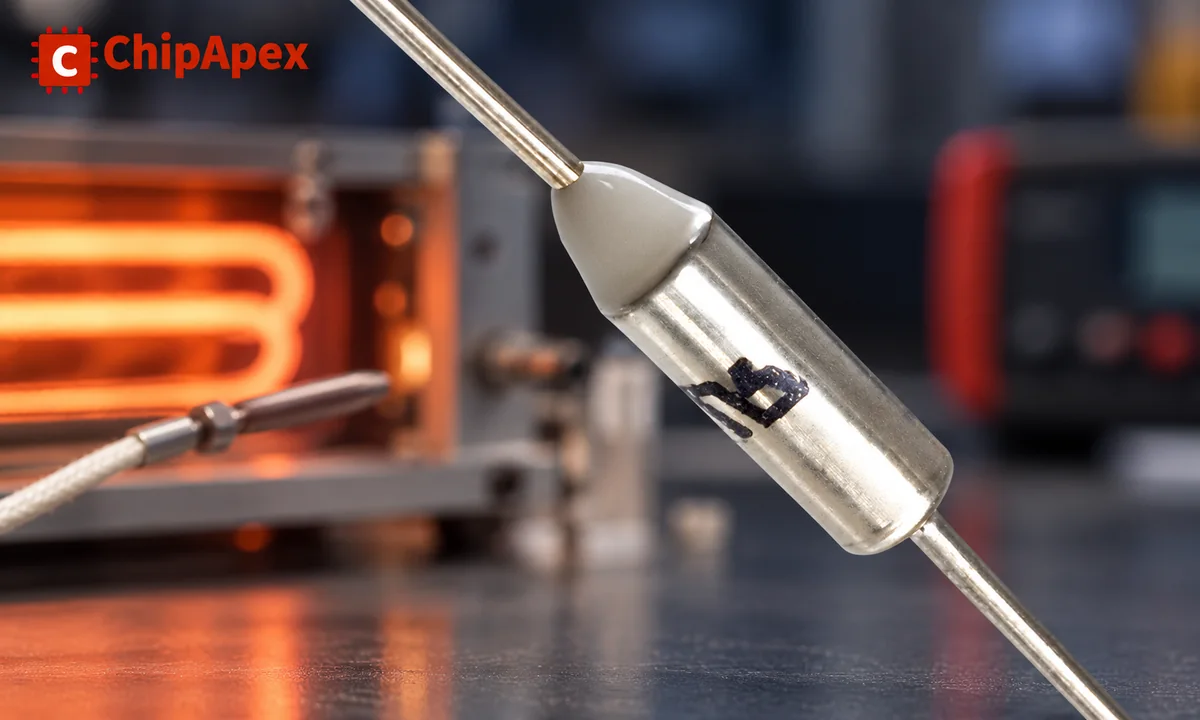
A heater can overheat even when current remains near its normal value. Blocked airflow, a failed temperature controller or poor thermal contact can prevent heat from leaving the protected area. A temperature-sensitive cutoff addresses this kind of fault by opening the circuit when its sensing mechanism operates.
A thermal fuse is usually a one-shot device. After operation, it must be replaced with an appropriate part and the cause of overheating corrected. A resettable thermal protector and a thermostat have different operating behavior, even though catalog terminology sometimes groups them under thermal cutoffs.
In a typical protection arrangement, the thermostat or electronic controller regulates normal operation. The thermal fuse interrupts the relevant circuit if abnormal heat reaches its location. Its effectiveness depends on where it is mounted and how quickly heat reaches it.
Some thermal fuses use a temperature-sensitive pellet that restrains a spring-loaded contact mechanism. When the pellet changes state, the contacts separate. Other designs use a fusible alloy that separates when heated under specified conditions. Package materials and internal construction vary.
The sensing mechanism responds to its own local temperature. That temperature depends on surrounding heat, heat conducted through the leads and self-heating from the current. A fuse attached to a motor winding can therefore experience a different temperature from a sensor elsewhere in the same enclosure.
The manufacturer's thermal-fuse application notes describe pellet operation, mounting and electrical considerations. Their installation instructions apply to the relevant series; dimensions and assembly limits should not be transferred automatically to another product.
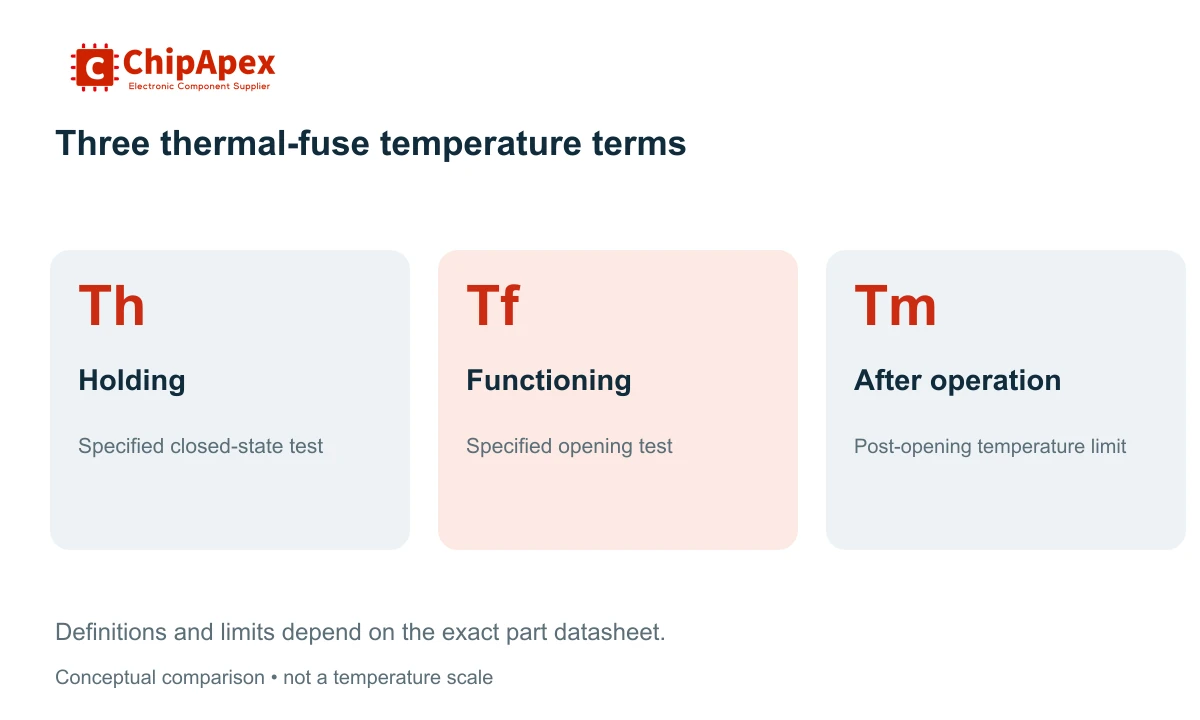
The temperature printed on a fuse is not a complete selection specification. Read all relevant temperature definitions in the exact manufacturer's datasheet.
| Term | What it describes | What it does not establish |
|---|---|---|
| Rated functioning temperature, Tf | The rated temperature associated with operation under a defined test method and tolerance | The exact temperature of the protected component when the installed fuse opens |
| Holding temperature, Th | A defined temperature at which the fuse remains conductive during a specified endurance test and electrical condition | Unlimited service life at that temperature |
| Maximum temperature limit, Tm | A specified upper temperature condition after the fuse has operated, with required post-operation integrity | A temperature at which the closed fuse may run normally |
| Maximum operating or use temperature, where specified | The manufacturer's permitted operating-temperature condition | A universal substitute for Th or Tf |
The manufacturer's thermal-link reference explains construction and temperature terms for its series. Tolerances and endurance conditions vary, so retain the part-specific definitions when comparing alternatives.
Suppose an illustrative installation reaches 90°C at the proposed fuse body in normal use, with a brief higher temperature after the heater switches off. Selecting a fuse simply because its Tf is above 90°C is insufficient. Its allowed continuous condition, normal overshoot, manufacturing variation and abnormal-fault response all need examination.
Heat stored in a heater or nearby metal can continue moving toward the fuse after power is removed. Check that post-operation overshoot remains within the device's specified limit. A cutoff that opens successfully can still be exposed to damaging heat afterward.
| Device | Main response | Behavior after operation |
|---|---|---|
| One-shot thermal fuse | Local temperature reaching its operating condition | Permanently open; replacement required |
| Resettable thermal protector or thermostat | Temperature reaching its switching condition | May reset automatically or manually, depending on design |
| Current fuse | Heating of an element caused by current over time | Typically permanently open |
| PPTC resettable fuse | Combined effects of current and temperature | High-resistance state; recovery depends on removal of fault and cooling |
ptc resettable fuses are useful for specified current-limiting duties, but their behavior differs from a one-shot thermal link. A tripped PPTC can pass residual current and does not provide the same permanent open circuit.
Conventional electrical fuses address overcurrent within their time-current and interrupting ratings. A thermal fuse can supplement that protection where overheating may occur without enough overcurrent to open the current fuse. One should not be treated as an automatic replacement for the other.
The fuse must carry normal current without unacceptable self-heating and interrupt the specified circuit when it operates. Check rated voltage, rated current, AC or DC suitability and any load restrictions for the exact part.
An AC rating does not automatically permit the same duty on DC. DC interruption can be more demanding because the current has no periodic natural zero crossing. Use a published DC rating or an application assessment from the manufacturer where required.
Current also affects the sensing temperature through I²R heating. Different lead sizes, connections or current levels can change how hot the fuse runs. A replacement with the same printed Tf can therefore behave differently if its construction or electrical rating differs.
For example, a hypothetical 1,200 W resistive heater operating at 120 V draws approximately 10 A at that operating point. The fuse still needs the appropriate voltage and interrupting duty, thermal margin, approvals and installation validation. Selecting a 10 A part solely from that calculation would omit those constraints.
Place the device where it can sense the relevant overheating condition while remaining within its permitted conditions during normal operation. Record how it touches the protected surface, what insulation surrounds it and how the leads conduct heat away. A small relocation can change response time.
Follow the manufacturer's lead-forming and connection instructions. Bending too close to the body can damage the seal or internal assembly. Soldering can heat the sensing element enough to alter or operate it. Use the approved process, lead distance, heat control and inspection method for the chosen part.
A crimped connection also requires control. Poor contact can create local heating that changes the fuse temperature even if the rest of the equipment is behaving normally. The connection must meet its electrical, mechanical and thermal requirements together.
Do not use a universal soldering time, bend radius or distance copied from a different series. Compare actual production parts after assembly, including sleeves and adhesives. Those materials affect both electrical insulation and heat transfer.
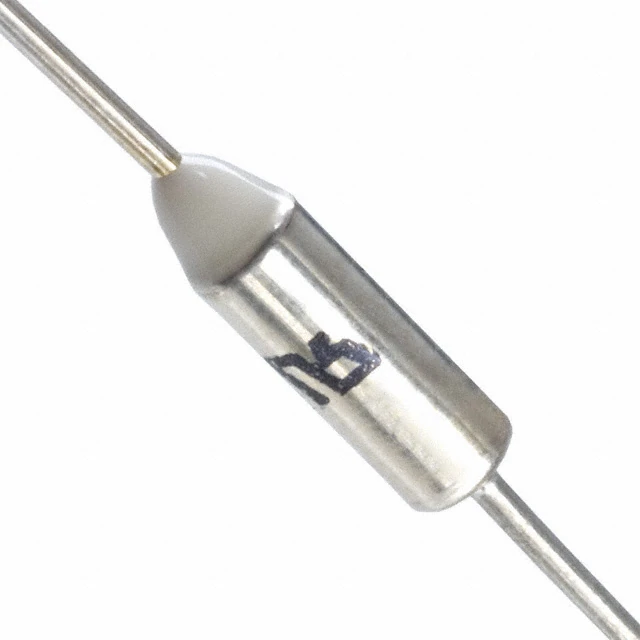
For design validation, measure temperatures at the proposed fuse location during worst-case normal operation and foreseeable faults. Include startup, shutdown heat soak, input variation and the required installation conditions. The normal controller's failure is often a relevant scenario in a heating application.
Confirm that the device remains conductive during permitted operation and interrupts before the protected assembly exceeds its allowed condition. After opening, evaluate continuing temperature rise and electrical integrity. Review the complete assembly's applicable requirements with the qualified test process.
A continuity test on a disconnected, cooled fuse can indicate whether its path is open. It cannot prove the remaining thermal calibration or reproduce the certified operating test. An open fuse also does not identify the root cause: airflow, control faults, assembly heating and prior damage all require consideration.
The manufacturer's thermal-cutoff catalog illustrates why temperature and electrical ratings are specified together. Sourcing within a broader circuit protection range should retain this device-specific review.
A conventional one-shot thermal fuse cannot be reset after it opens. A thermostat or resettable protector may restore its state, but that is a different device. Identify the original component from its part number and datasheet. Replacing a permanent cutoff with a resetting device changes the protection behavior.
It is a rated value associated with defined test conditions and a specified tolerance. The protected object's temperature when the installed fuse opens also depends on heat transfer and response delay. Read the manufacturer's Tf definition and any separate functioning-temperature specification rather than assuming an exact installed switching point.
Increasing the rating can allow the protected assembly to become hotter before interruption. Use the specified replacement or an approved equivalent with the required thermal, electrical and mechanical characteristics. Correct the overheating fault as part of replacement; a higher rating is not a remedy for repeated operation.
With the equipment isolated from power and stored energy safely discharged, follow the service procedure and isolate the fuse from parallel circuit paths before measuring continuity. An open reading supports an interrupted fuse path. It does not prove why it opened, and continuity alone cannot verify its thermal performance.
The original thermal fault may remain, the replacement may not match the specification, or assembly heat may have affected it. Poor crimps, altered mounting and different insulation can also change its temperature. Recheck the full operating and installation conditions. Bypassing the fuse removes the intended final interruption.
For a ChipApex sourcing request, provide the original part number, Tf, Th, Tm, electrical rating, AC or DC load, body and lead dimensions, required approvals and quantity. For a new design, add the measured normal and fault temperatures at the proposed location.

What is EEPROM? Learn byte-level storage, EEPROM vs Flash, I2C/SPI, BOM selection & sourcing risks. Authentic EEPROMs at ChipApex.
View details
Compare RC, crystal and MEMS oscillator circuits. Check ppm, jitter, load capacitance, startup margin and output compatibility before choosing a clock source.
View details
Learn the relay definition, coil and contact operation, NO and NC forms, load ratings and suppression choices. Compare mechanical, reed and solid-state types.
View details
Stop guessing which Op-Amp to use. We break down GBWP, Slew Rate, and Offset Voltage with real engineering insights. Find the right parts like NE5532DR & LM358DR at ChipApex.
View details
The activity of extra discounts on wholesale prices is in full swing…
Please fill in your contact information and we will send you the latest wholesale price list.

