 ChipApex | Global Electronic Components Supplier

SEARCH
Search Product
Search Post
— IC芯片 | 连接器 | 传感器 | 被动器件 —
Search productSearch post
— IC芯片 | 连接器 | 传感器 | 被动器件 —
The trend of science and technology is changing rapidly.
A contactor is an electrically operated switch that makes and breaks a power circuit, commonly for motors, heaters or lighting. Energizing its coil changes the state of the main contacts. Auxiliary contacts provide status or control signals. Selection depends on the load, switching duty, control voltage and the protection devices used with it.
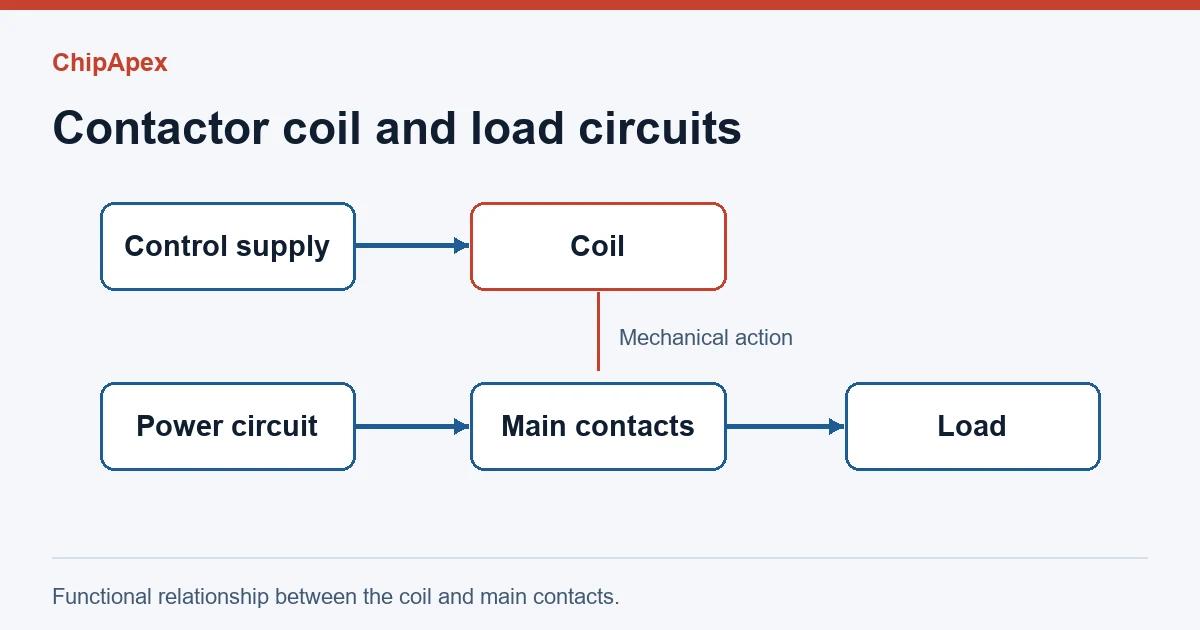
A typical magnetic contactor uses an energized coil to draw an armature toward a magnetic core. The armature moves the main contacts. In a common normally open design, the load circuit closes while the coil is energized and opens under spring force when the coil is de-energized. Other designs can latch, so confirm the operating sequence in the manufacturer’s documentation.
The coil circuit and the load circuit have different specifications. A 24 V DC coil can control a contactor that switches a higher AC load voltage, provided that the model is rated for both conditions. Main poles carry load current. Auxiliary contacts are sized for their own signaling or control duty. Consult the device drawing before assuming terminal numbers or contact states. ABB contactor and overload relay guide
| Device | Usual role | Selection check |
|---|---|---|
| Control relay | Switches signals or other rated control loads | Contact material and the switching load rating |
| Contactor | Repeatedly switches rated power loads | Utilization category, voltage, current and switching frequency |
| Motor starter | Controls a motor and includes overload protection | Motor data, overload setting and coordinated short-circuit protection |
These terms overlap across product families. A power relay may switch substantial current. Compare rated duty, load and service life at the specified voltage rather than relying on the product name.
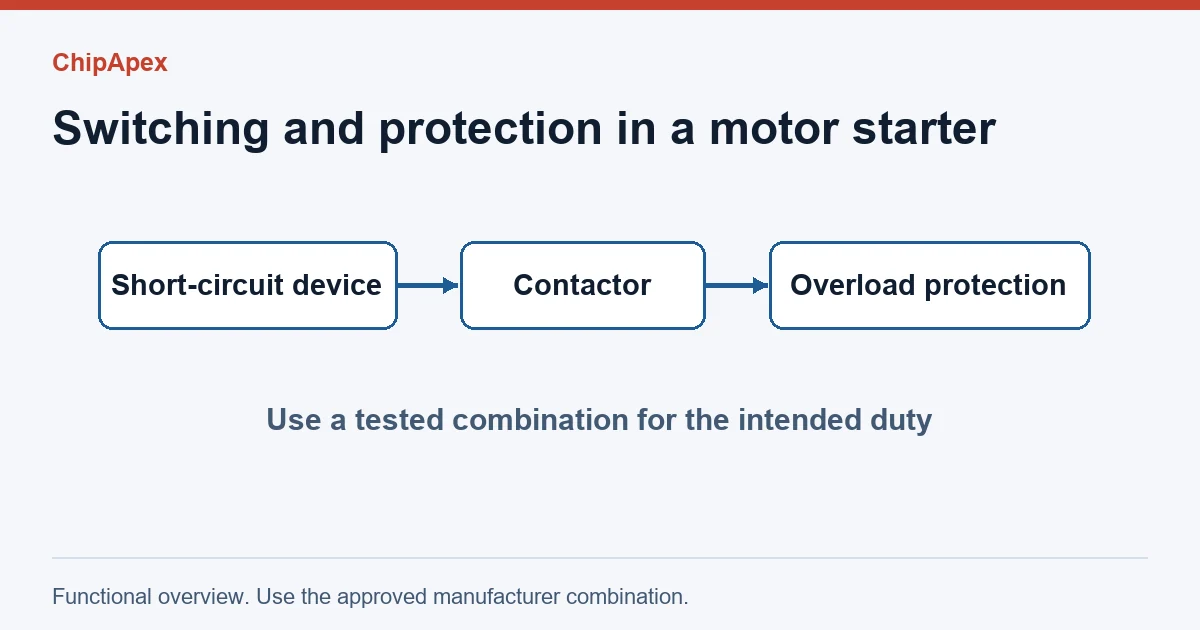
An overload relay responds to sustained overcurrent under its operating characteristic. A separate coordinated fuse or circuit breaker is generally used for short-circuit protection. Use the manufacturer’s tested combinations and applicable project requirements. A contactor by itself does not establish a starter’s protective performance.
Imagine a 400 V three-phase squirrel-cage motor marked 7 A and a panel with a 24 V DC control supply. For normal start and stop duty, look for a contactor with a suitable three-phase motor rating, commonly AC-3 for this type of application, at 400 V. Check the manufacturer’s limits at the operating temperature and expected number of starts. A large resistive-load ampere rating alone is insufficient. Jogging, plugging or frequent reversal can require AC-4 evaluation. Schneider Electric utilization category explanation
The next checks are practical. Verify the exact coil variant and supply range. Confirm the number of poles and the auxiliary contacts for monitoring or control. Compare the short-circuit protective device and overload relay with published coordination data. For a DC load, use an explicit DC switching rating. Consult the manufacturer’s drawing and have installation performed by qualified personnel.
ChipApex’s relays catalog can help with related control components. For a sourcing request, provide the original part number, coil supply, load nameplate data, duty category, mounting and required auxiliary contacts.
A standard contactor opens or closes the load circuit. Overload detection requires a suitable protective device and control arrangement.
Typical applications include switching motors, heaters and lighting circuits, provided that the contactor has the applicable rating for the load and duty.
Different categories test different switching stresses. Compare utilization category, operating voltage and the manufacturer’s motor table.
Only when the selected model has an explicit rating for that DC load and circuit arrangement. DC arc interruption behaves differently from AC.
Possible causes include a control supply that sags, an unsuitable coil variant, a loose control connection or a mechanical problem. Have a technician compare against the manufacturer’s troubleshooting guidance.
See how avalanche photodiodes multiply photocurrent and compare APD and PIN detectors by gain, noise, bias, bandwidth and operating temperature.
View details
Learn how audio amplifiers work, compare Class AB vs. Class D, and discover key metrics (THD+N, SNR). Source authentic TI/ST audio ICs at ChipApex for your design.
View details
Learn how a diode conducts, how to identify anode and cathode, and when to choose rectifier, TVS, Zener or photodiode types for a circuit.
View details
A comparator checks which of two input voltages is higher and changes its output state accordingly. It is useful when an analog signal must trigger a clear decision, such as an overvoltage warning or sensor threshold. Its input range, output type,...
View details
The activity of extra discounts on wholesale prices is in full swing…
Please fill in your contact information and we will send you the latest wholesale price list.

